Robotics Sector: How to Write Your Pitch Deck
















Want to know exactly how VCs evaluate your robotics startup?
Together with Undeterred and AlleyCorp — some of the leading robotics VCs— we’ve written this guide to unpack the inside baseball on how VCs evaluate robotics startups, and in turn how you can raise a successful round.
Informed by reviewing thousands of decks, and insights on which startups get the most traction on Deep Checks, this playbook helps put together a teaser deck that gets your first VC pitch scheduled.
We’ll go slide by slide on how investors decide whether or not to move forward with a startup. It’ll cover:
- Problem: Demonstrating how you’re solving a burning pain point for your customers
- Solution: Show why you have the best solution to this problem
- Technical risk: How to convince investors to get behind the remaining technical risk that you have
- Why now?: Demonstrating why your startup has just become possible to build. This is make-or-break for many pitches
- Traction: How to show there’s demand for your product before the market has adopted it
- Business Model: How VCs think about your economics
- Market Size: Why bottom up beats top down
- Go to market: Showing you can become big enough, fast enough
- Competition: As markets become crowded, how to create defensibility
- Team: What makes for a world-class founding team?
- The Ask: Use of proceeds and round size
- Pitching: Do’s and dont’s of pitching your startup to VCs
Problem
Demonstrating you're solving a burning pain point for your customers
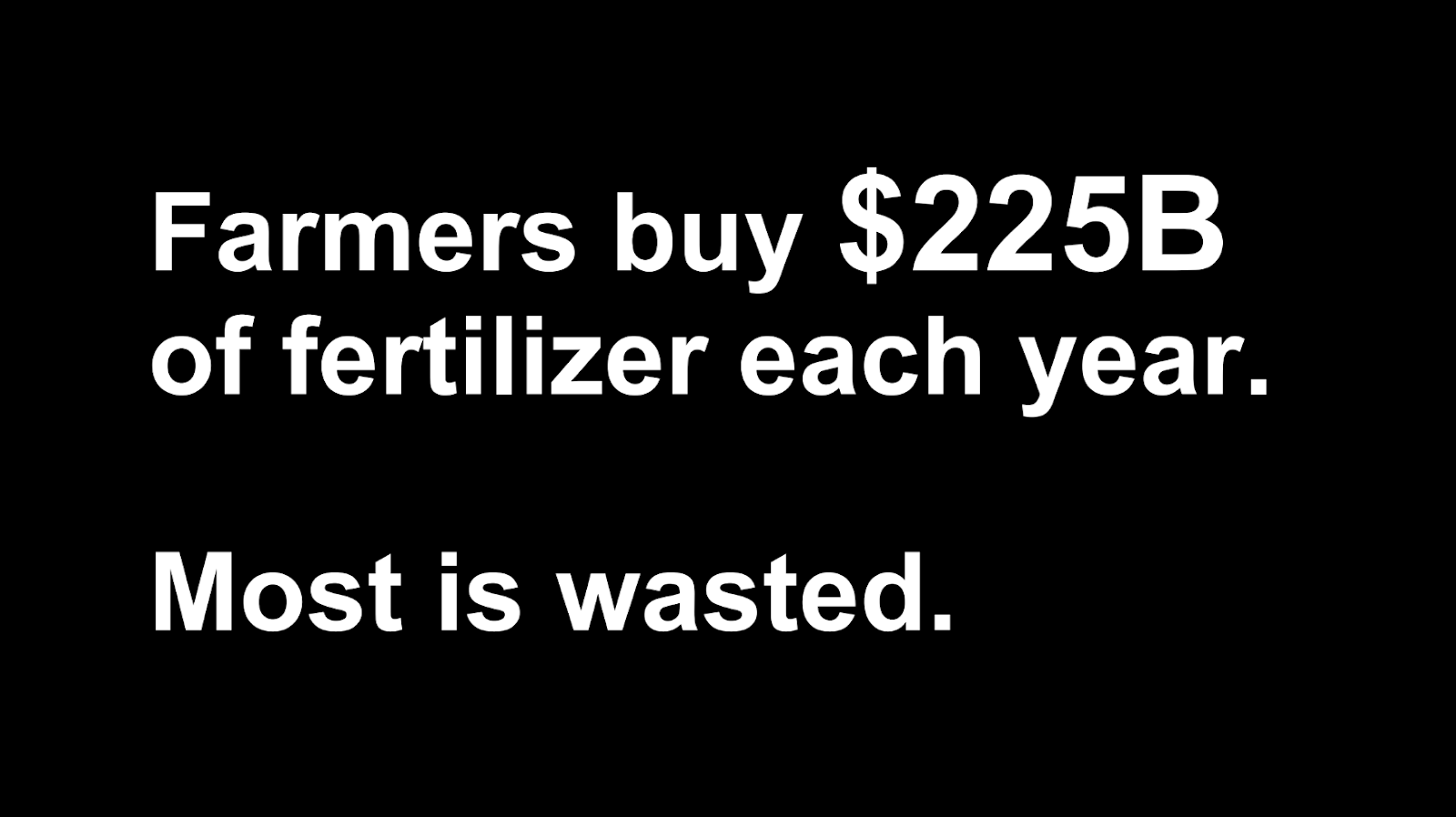
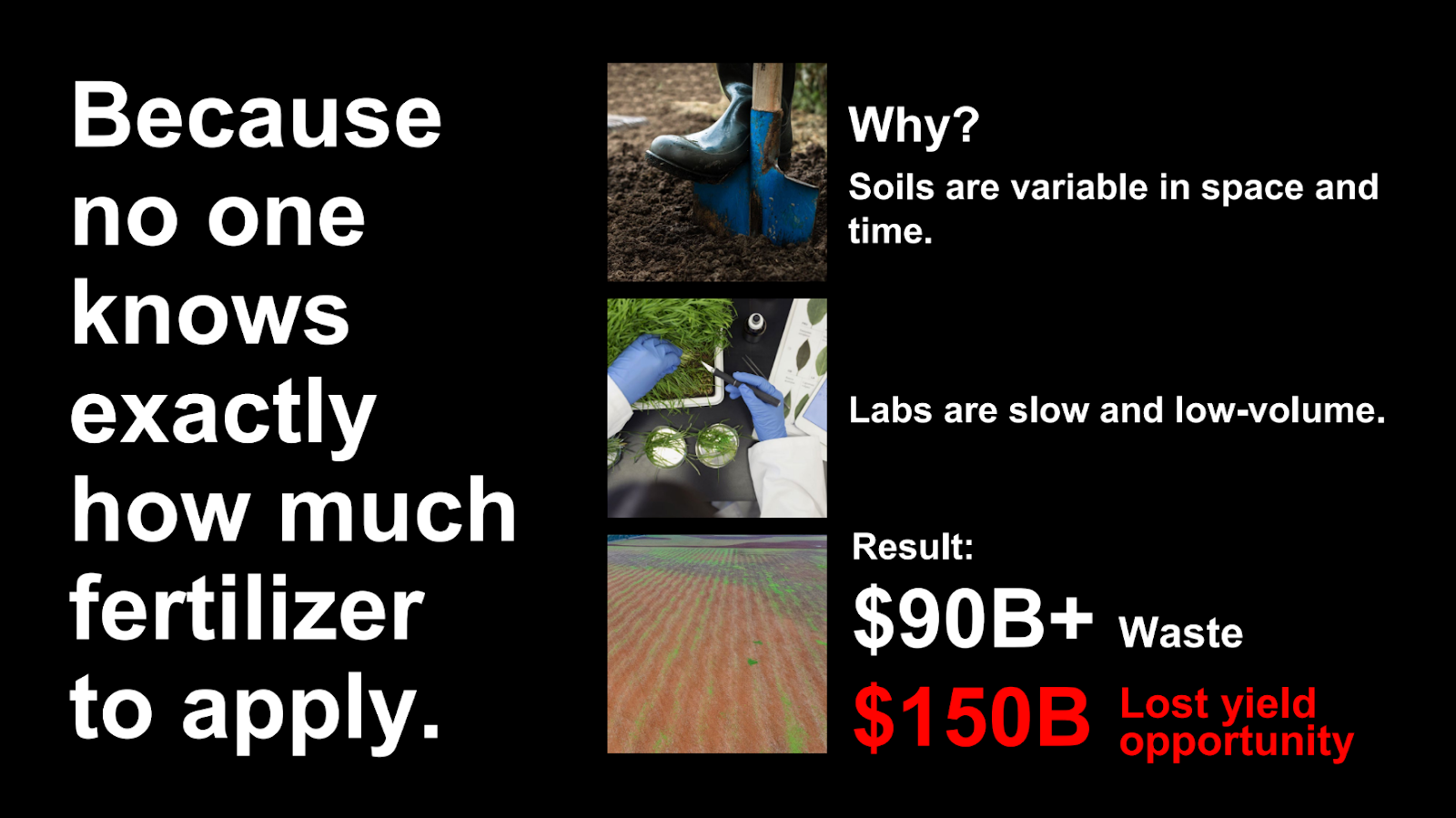
The problem slide exists to convince VCs the pain point you’re solving for your customers is a large, distinct, burning issue that they are willing to endure switching costs to solve.
Robotics problems typically fall into one of three categories: labor shortage/cost, precision/consistency requirements, or safety/environmental hazards. The most compelling robotics pitches address all three, and quantify the operational pain point with specific metrics:
- Labor economics: Manufacturing facilities struggling with 10-15% unfilled positions, warehouse operators facing 100%+ annual turnover, or agricultural operations unable to find seasonal labor at any price point
- Quality/consistency gaps: Production defect rates of 2-5%+ due to human variability, inspection processes that miss critical flaws, or tasks requiring sub-millimeter precision that humans cannot reliably achieve
- Safety/hazard exposure: Industries with injury rates 3-4x the national average, tasks in extreme temperatures or toxic environments, or repetitive motions causing chronic injuries
The best way to describe the problem your customers face is to start with a slide that outlines the general industry challenge that you are addressing. From here, the next slide should outline the specific problem your end customers face, and the direct business implications of it.
What gets VCs excited
- Problems where the economic pain is 10x the cost of the solution (e.g., labor costs $150K/year per person, robot costs $50K and can work around the clock)
- Problems that are getting worse over time (aging workforce or infrastructure, increasing regulatory requirements, supply chain pressures)
- Clear evidence that customers are currently using expensive workarounds (overtime pay, outsourcing, accepting quality issues)
- Vertical specific robotics that unlock stronger business outcomes than existing solutions (by replacing arduous labor, delivering stronger production or operation economics, etc)
Red flags
- "Nice-to-have" problems that customers aren't actively solving today
- Problems that could be solved with better software or process changes rather than robotics
- Focusing on technology challenges ("vision systems can't handle occlusion") rather than customer outcomes
- Generic statements about labor shortages without specific customer validation or quantification
- Problems that only matter at massive scale (signals you need to be very large before economics work)
Solution
Show why your solution is the best solution to this problem
The solutions slide demonstrates why you have the best solution to the problem your customers face.
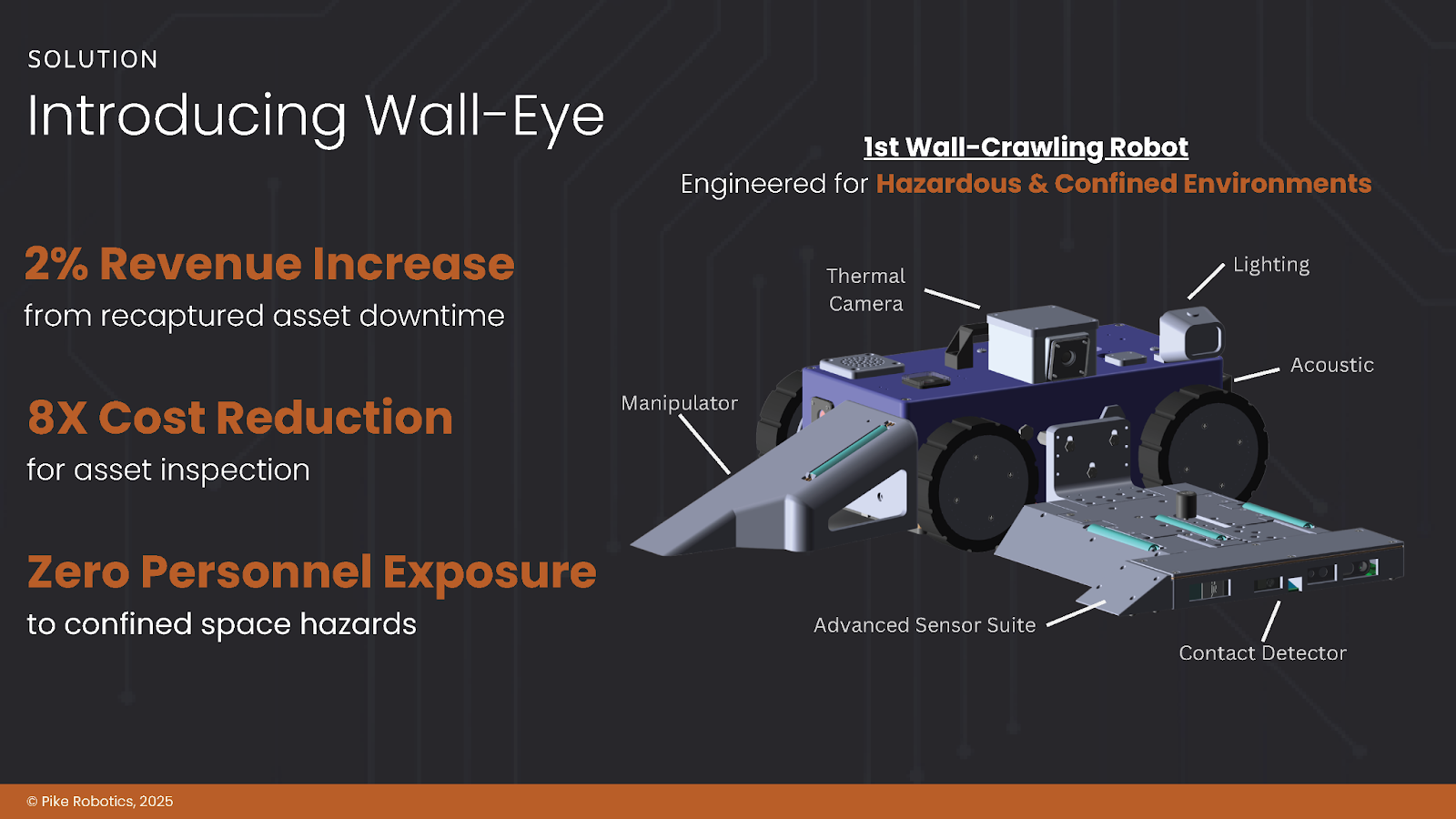
Effective robotics solution slides bridge the gap between technical capability and business value. Rather than leading with hardware specifications, show how your robot's capabilities translate to customer ROI:
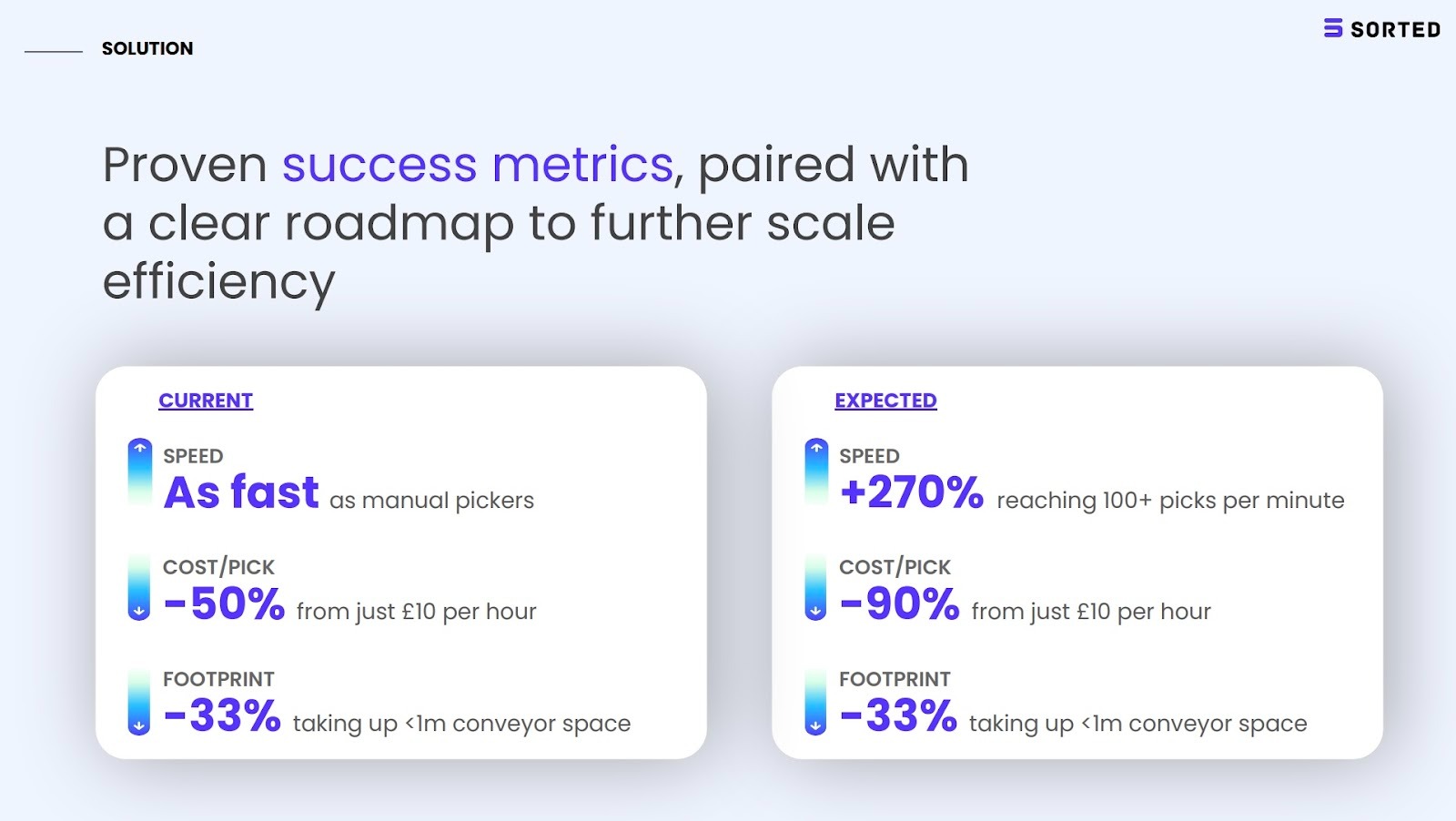
- Quantified performance metrics: "Achieves 99.8% pick accuracy at 45 picks per minute" rather than "uses advanced computer vision"
- Direct cost comparison: "Replaces 2.5 FTEs at $120K total cost vs. $375K in annual labor" with clear payback period (typically 12-24 months for strong robotics businesses)
- Operational improvements: "Reduces defect rate from 3.2% to 0.4%, saving $800K in rework annually"
- Deployment characteristics: "Installs in 3 days with no facility modifications, runs 22 hours/day" (shows ease of adoption)
For robotics, the solution must address why the robot is better than: (1) hiring more people, (2) traditional fixed automation, and (3) competing robotic approaches. Hence, your slide should address the distinct benefits, economic argument for adoption, and feasibility of integration you have.
What gets VCs excited
- Clear payback period under 24 months (ideally 12-18 months) with conservative assumptions OR immediately compelling unit economics on a robot-as-a-service model
- Solutions that address multiple pain points simultaneously (e.g., reduces costs AND improves safety AND increases throughput)
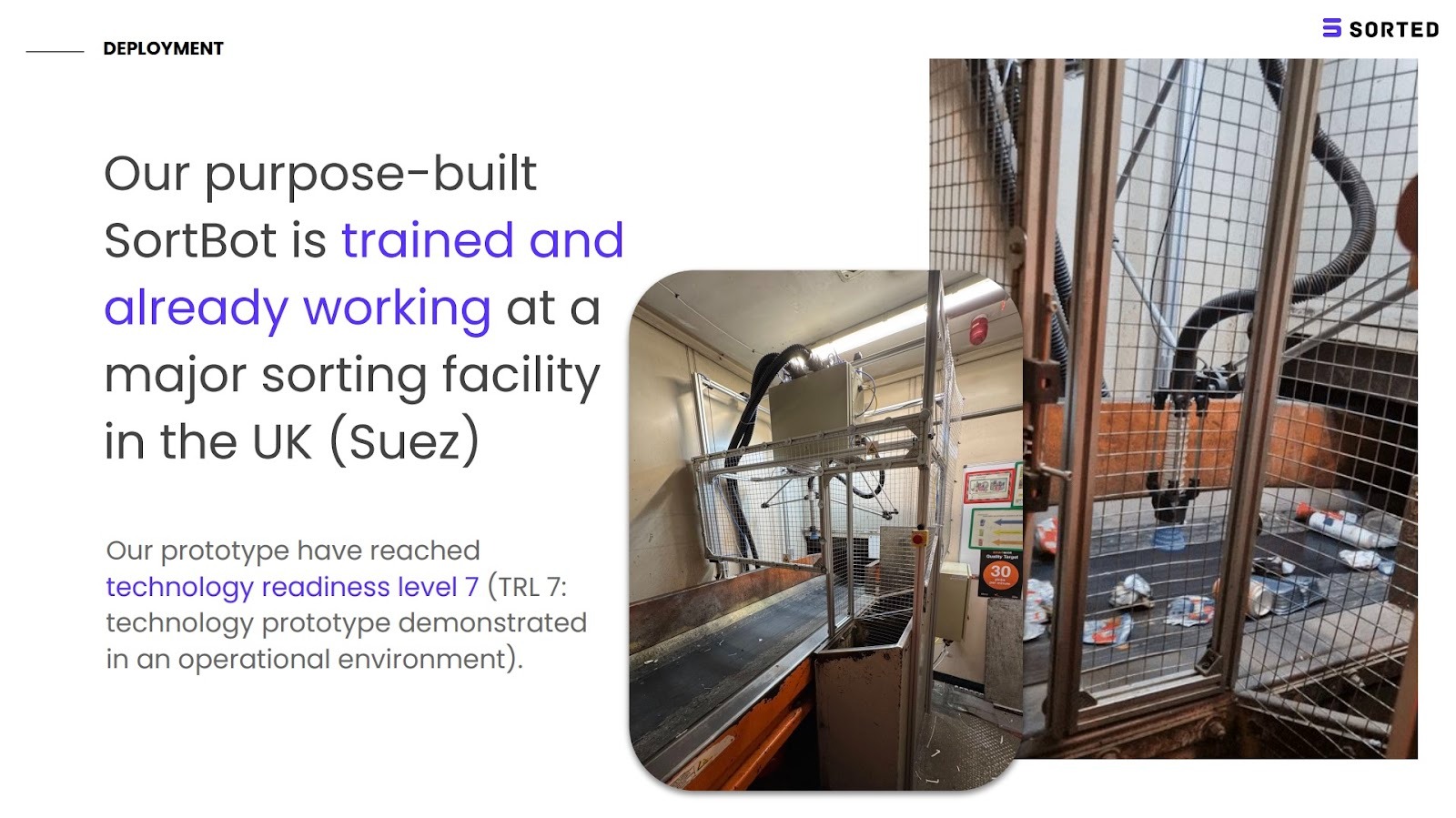
- Evidence that your solution works in real operational environments, not just controlled lab settings
- Demonstration of how the solution improves over time (through software updates, learning, or accumulated data)
- Solutions with clear upgrade or expansion paths within the customer (land-and-expand potential)
Red flags
- Payback periods over 3 years (suggests weak economics or that you're not solving a critical problem)
- Leading with technology specs ("6-axis arm with 5kg payload") before showing business value
- Comparing only to human labor without addressing why existing automation solutions don't work
- Claiming you can "do anything" a human can—shows lack of focus and understanding of robotics limitations
- Missing critical deployment requirements (integration time, facility modifications, ongoing maintenance)
Technical Risk
How to convince investors to get behind the remaining technical risk that you have
After your solution slide, investors will want to know what your technology is and what your unique insight to be able to build it was. This slide should highlight any remaining customer benefits not covered in the solution slide.
Within robotics, this is usually tied to how close your robot is to operating in real world conditions, and how close it is to performing at the rate and efficacy required by your end customers.
Investors evaluate risk across multiple integrated systems:
- Perception and sensing risk: Can your system reliably perceive its environment in real-world conditions (variable lighting, occlusions, novel objects)? Demonstrate with diversity of test scenarios, not just controlled demos. Show failure modes and how you handle them.
- Manipulation and control risk: Can you achieve the required dexterity, force control, or motion precision consistently? Show cycle time consistency, success rates across object variability, and performance degradation analysis.
- Integration and deployment risk: Can you deploy in customer environments without extensive customization or long integration time? Prove with multiple installations or show a clear path from pilot to production deployment (installation time, calibration requirements, IT integration).
- Reliability and uptime risk: Will it work for thousands of hours without failure? Customers need strong uptime for robotics to be viable.
- Safety certification risk: For collaborative robots, can you achieve necessary safety certifications (ISO 13849, ISO 10218)?
Most importantly for robotics: show you understand the difference between "works in demo" and "works in production." Address: What's your mean time between failures? How do you handle edge cases? What's your recovery strategy when the robot gets stuck? How does performance degrade in real world conditions?
Your technical risk slide should show how far along in development you are in these dimensions. You can include things like a technical diagram, TRL, and demonstrated performance metrics.
What gets VCs excited
- Robots already deployed in real customer environments
- Clear delineation of what's solved vs. what needs engineering work, with credible timeline (3-12 months) and team capability
- Evidence that your approach handles real-world variability (show success across different customer sites, object variations, or environmental conditions)
- Proprietary technical insights or IP that make your approach fundamentally better (not just "we trained a better model")
- Evidence that the robot improves with deployment (fleet learning, continuous improvement)
- Teams that have successfully shipped physical products before (shows they understand manufacturing, reliability, field support)
Red flags
- "It works perfectly in our lab" without proof of real-world deployment
- Reliance on breakthroughs in fundamental robotics ("we'll use reinforcement learning to solve dexterous manipulation")—shows scientific risk
- No discussion of failure modes or degraded performance scenarios
- Overreliance on a single novel component or technology ("our special gripper is the key")—creates fragility
- Long list of remaining technical tasks without clear prioritization or validation strategy
- Teams without manufacturing or field deployment experience trying to build complex hardware
Why Now
Demonstrating why your startup has just become possible to build
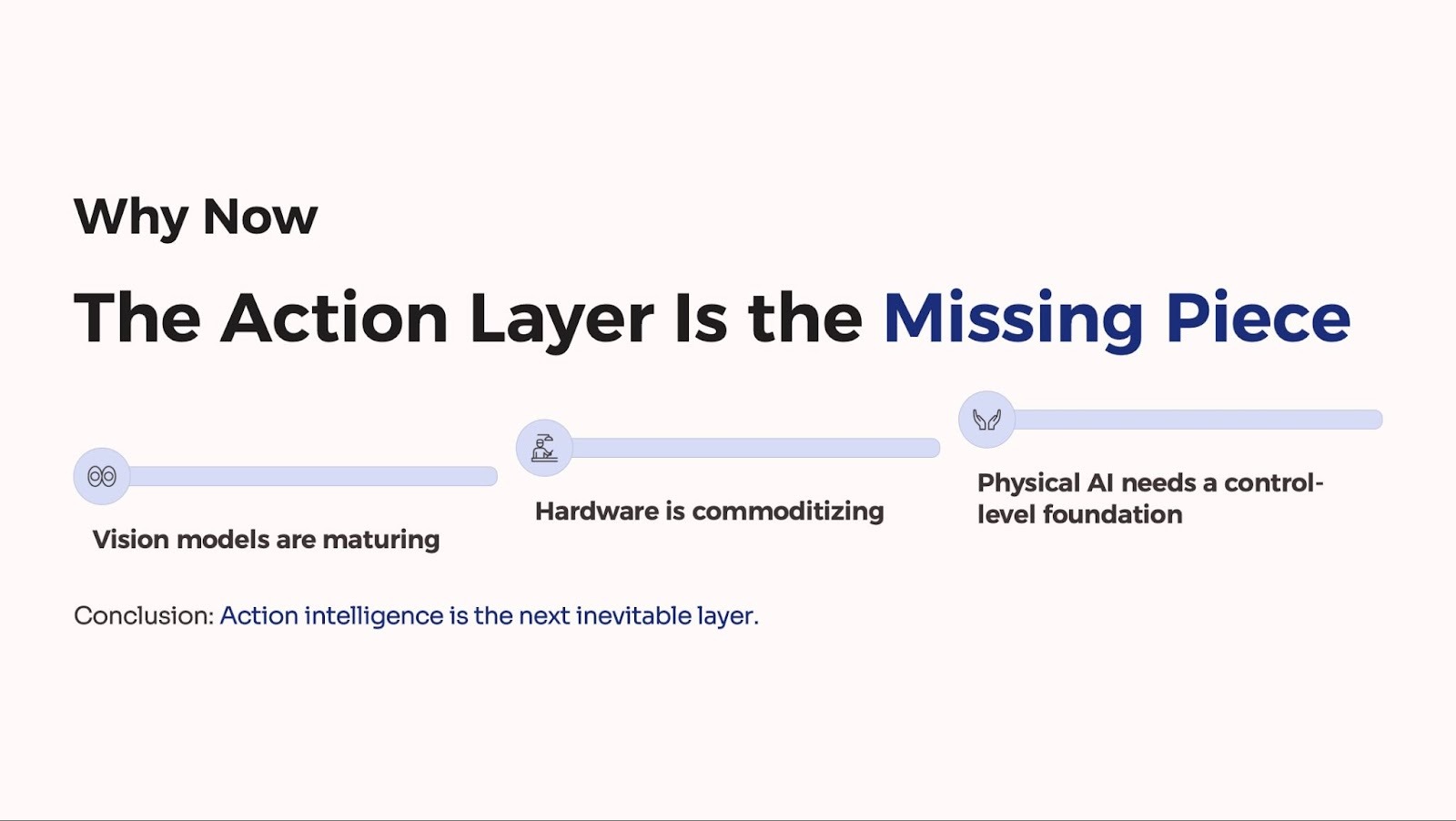
Many times, ideas have been tried before and failed to materialize. By describing what has changed in the world that makes it uniquely possible to build your business today, investors gain confidence in your business. Timing is everything.
Inflection points across technology, policy, consumer behavior, or buyer demand create compelling narratives to demonstrate this. The "why now" slide is used to describe the trends relevant to your startup.
"Why now" is especially critical for robotics because the field has a 50+ year history of overpromising and underdelivering. Arguments that resonate to VCs include:
- Foundation model revolution: Pre-trained vision and language models have made perception and task planning dramatically easier. What required custom datasets and months of training now works out-of-the-box.
- Cost curve inflections: LiDAR sensors that cost $75,000 in 2015 now cost $1,000. Industrial robot arms have dropped 40% in price in 5 years. Compute costs for edge AI are down 10x. Show how these cost curves make your unit economics work now when they didn't before.
- Labor market transformation: A generation of manual tradespeople are retiring out of the workforce. Manufacturing unfilled positions at highest levels in 20 years.
- Supply chain and component maturity: The smartphone revolution created massive supply chains for sensors, actuators, and compute. You can now build complex robots with off-the-shelf components that didn't exist 10 years ago.
- Customer acceptance and infrastructure: Warehouses now have WiFi and edge compute. Facilities are designed for robot-human collaboration. Procurement teams understand robot ROI. The market has matured to accept robotics solutions.
- Demand tailwinds: The data center and power production build-out requires an increase in skilled electricians and installers that simply cannot be met by re-training.
Most credible robotics "why now" arguments combine 2-3 of these factors, showing why your company has just become possible to bring to market.
What gets VCs excited
- Specific, quantified changes in enabling technologies ("Vision transformers reduced our labeling needs by 90%")
- Confluence of multiple trends making your solution newly viable (technology + economics + market demand)
- Evidence that customer willingness-to-adopt has shifted ("3 years ago prospects wanted proof of concept; now they're asking for delivery timelines")
- Recent failures of competing approaches that validate your different method
- Demonstration that you're uniquely positioned to capitalize on these trends due to team background or early insights
Red flags
- Generic claims about AI/ML without showing what specifically changed ("AI is getting better" doesn't cut it)
- Why now arguments based on hypothetical future improvements ("When GPT-7 comes out, it will enable...")
- Ignoring why previous robotics companies failed at similar problems
- Claiming your technology breakthrough is the "why now" (that's technical risk, not market timing)
- Labor shortage arguments without acknowledging that robotics has always claimed labor shortages as "why now"
Traction
How to show there's demand for your product before the market has adopted it
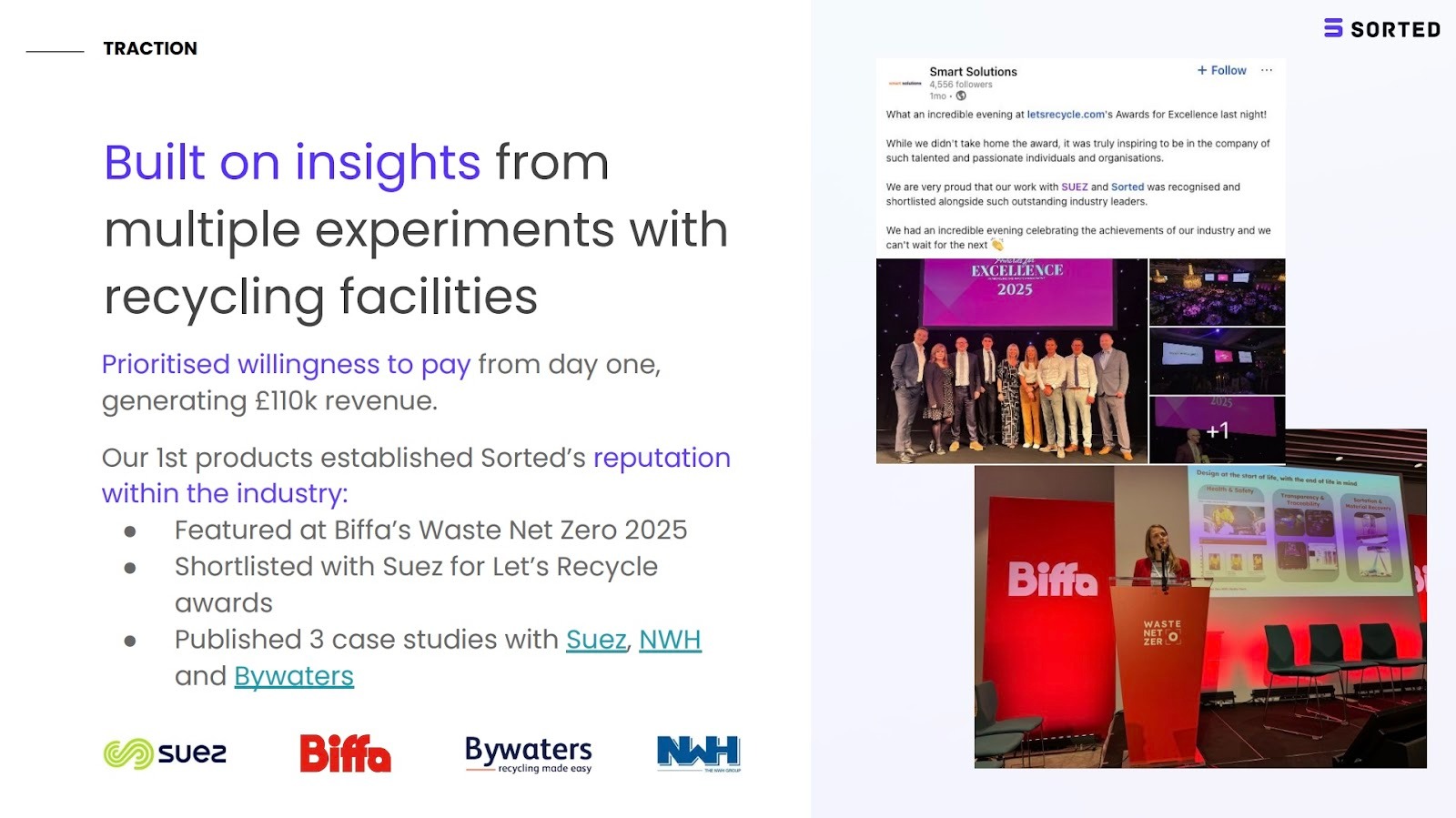
The traction slide is used to show the degree of progress you've made across all of these proof points.
Valuable indications of traction include:
- Pilot deployments (most valuable): Robots operating in real customer facilities, even if only 1-2 units. Critical metrics: How many hours deployed? What's the uptime? Are customers paying (even subsidized rates show commitment)?
- Letters of intent (LOIs): For robotics, LOIs must include specific conditions and volumes. "Will purchase 50 units upon achievement of 95% uptime over 90-day trial" is strong.
- Design partnerships: Customer co-development where they're investing resources (engineering time, facility access, data sharing). Show their skin in the game—are they assigning engineers? Sharing proprietary process information? Providing floor space?
- Customer discovery depth: For pre-product companies, show 50+ customer conversations with specific verticals. Document specific pain points, willingness-to-pay, purchasing process, success criteria. Include details like: Who's the economic buyer vs. technical evaluator? What's the approval process? What ROI threshold triggers purchase?
- Competitive displacement: If customers are currently using alternative solutions (manual labor, different automation, competitor robots), showing that they're willing to switch to evaluate yours is strong validation.
For robotics companies raising a Seed, you typically need at least 1-2 pilot deployments or very strong LOIs from credible customers.
What gets VCs excited
- Robots operating in customer facilities for 6+ months with documented performance data
- Customers paying something—even below cost—for pilots (shows serious intent)
- Evidence of land-and-expand: customers starting with 1-2 units and requesting 10-50 units upon success
- Multiple pilots across different customer sites showing the solution works broadly, not just in one facility
- Inbound interest from customers who weren't specifically targeted (word-of-mouth validation)
- Customer champions willing to speak with investors and provide references
Red flags
- Only demos in your own facility or lab (shows customer pain isn’t high enough to take the risk on letting you deploy)
- Multiple pilots that haven't converted to purchases or extended timelines (suggests product doesn't work well enough)
- LOIs without specific conditions or from customers who won't put engineering resources behind evaluation
- All traction with a single customer (de-risking concern—are you building a custom solution?)
- Long sales cycles (18+ months) without interim proof points or payments
Business Model
How VCs think about your economics
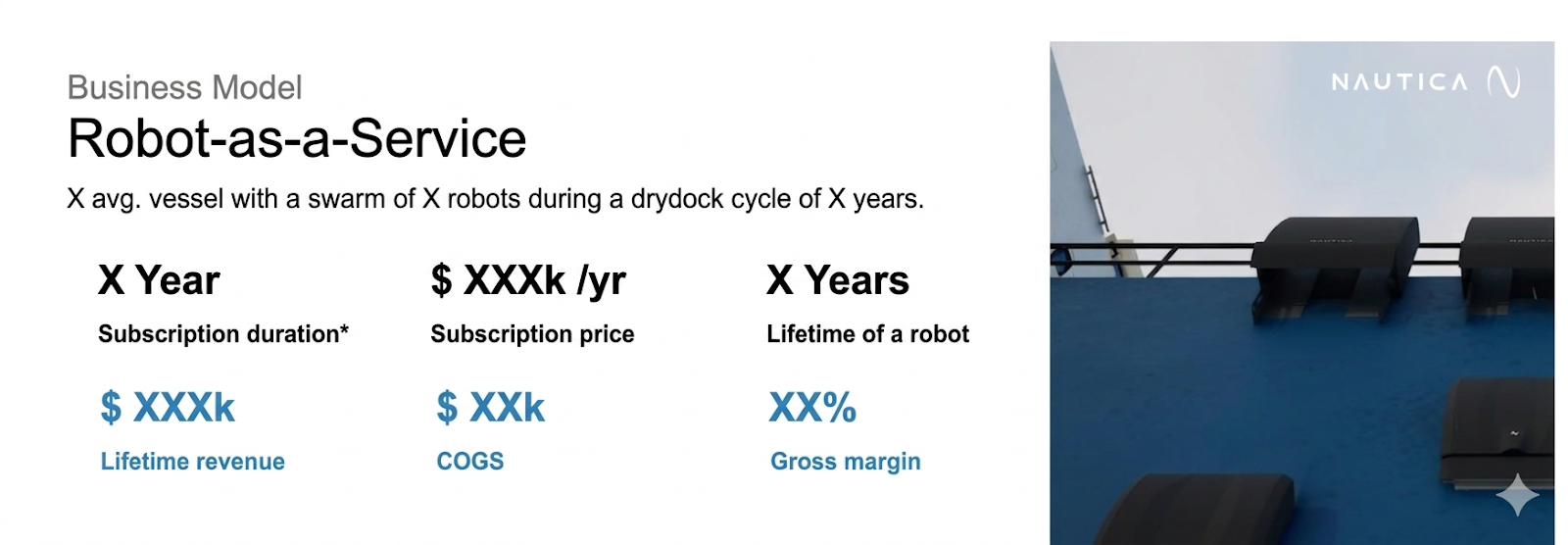
Your business model slide should include the basics of how you make money, the high level economics of price point to end customers, and margin you are able to achieve yourself.
VCs evaluate robotics economics across several dimensions:
Revenue model options
- CapEx (robot sales): Customer buys the robot outright. Typical gross margins 40-60% at scale. Advantage: faster revenue recognition. Disadvantage: higher customer acquisition friction, less recurring revenue.
- Robotics-as-a-Service (RaaS): Customer pays monthly/annual fee per robot. VCs increasingly prefer this model—creates recurring revenue, lowers customer adoption barriers, retains ownership of hardware (can redeploy or upgrade). Must show: (1) pricing covers COGS + service costs + margin, (2) payback period on hardware <24 months, (3) potential for multi-year contract lengths.
- Hybrid models: Partial upfront payment + ongoing service fees. Common in industrial robotics. Shows pricing flexibility.
- Unit-based pricing: Charge per pick, per item processed, per task completed. Aligns pricing with value delivered but requires robust telemetry and more complex billing. Best for applications where volume varies significantly.
Critical unit economics to show
- Hardware COGS: Cost to build one robot at current volumes vs. at 100 units vs. at 1,000 units. Show the path to margin improvement through volume, design optimization, and component cost reduction.
- Installation costs: What does it cost you to deploy a robot at a customer site?. Show current costs and path to reduction (better software, standardized installations, customer self-setup).
- Service and support costs: Ongoing costs for maintenance, repairs, software updates, customer support. For RaaS models, this directly impacts margin. Show current vs. projected as fleet grows.
- Customer acquisition costs (CAC): Robotics has notoriously high CAC due to long sales cycles, pilots, and technical sales. Show how CAC improves with scale.
Your business model should outline the price to your end customers, your business model, and your margins you can achieve at scale.
What gets VCs excited
- RaaS models with demonstrated customer willingness to pay monthly fees and multi-year contract commitments
- Clear path to strong gross margins at scale
- Evidence that support costs don't scale linearly with fleet size (software-based diagnostics, remote troubleshooting, predictive maintenance)
- Land-and-expand dynamics where initial deployment leads to 5-10x expansion within customer
- Pricing that's 30-50% of the labor cost it replaces (strong ROI for customer, healthy margin for you)
- Demonstrated pricing power or premium pricing for superior performance/reliability
Red flags
- Gross margins below 40% even at scale (suggests commodity hardware without differentiation)
- Installation costs that remain high at scale (signals complex deployment that won't improve)
- Service costs that scale linearly or super-linearly with fleet size
- RaaS pricing that doesn't cover COGS amortization + service costs + customer acquisition within 2 years
- No clear path to strong margins
- Business model assumes customers buy many robots without land-and-expand proof
Market Size
Why bottom up beats top down
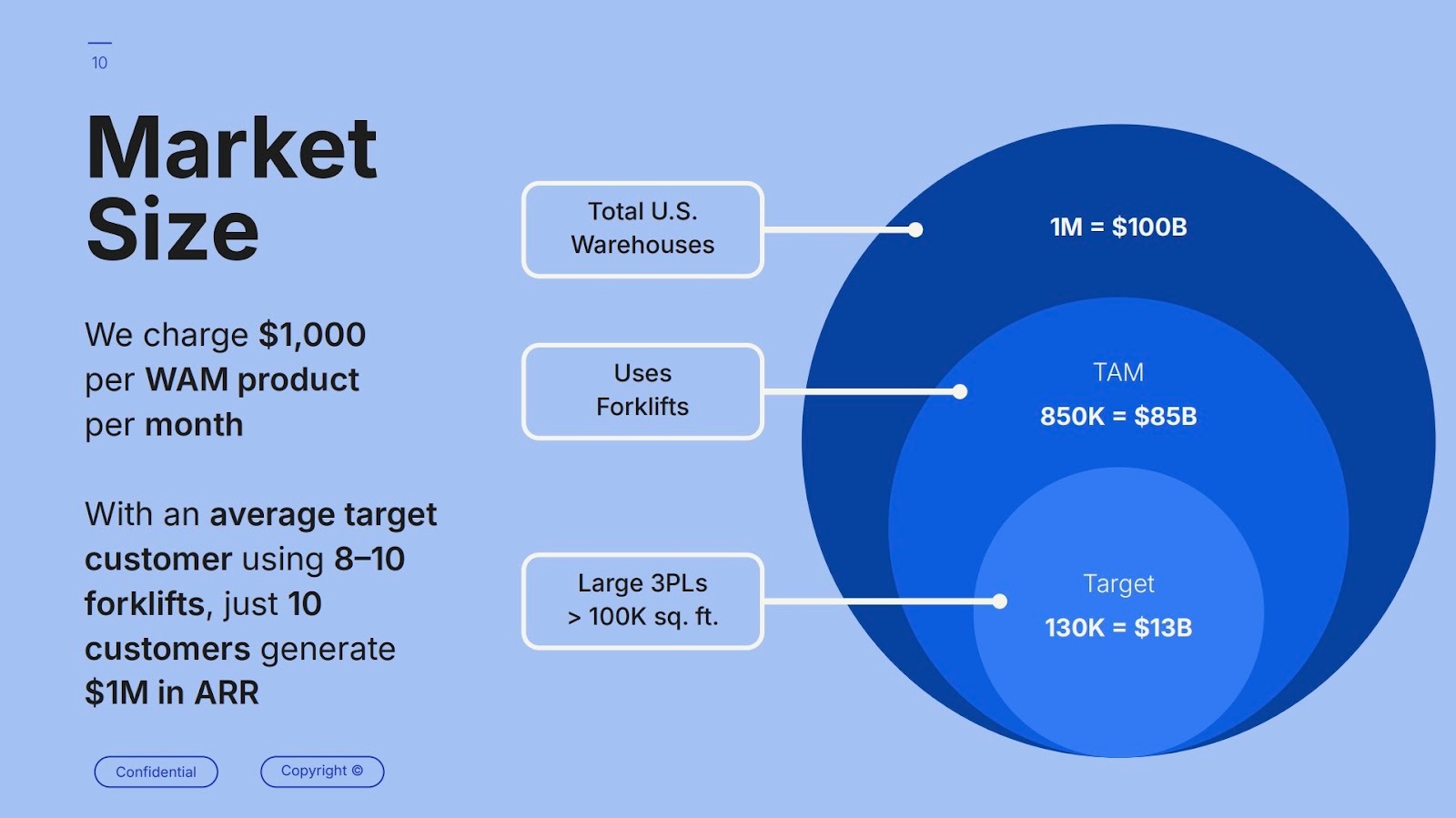
Your market sizing slide should be broken down into your:
Total addressable market: The total market size your business could theoretically capture.
Serviceable addressable market: The portion of the TAM you could realistically capture with your business model, geography, and resources.
Serviceable obtainable market: The portion of the SAM you are targeting in the short term.
For robotics specifically:
- SAM requires technical constraints: Your robot has technical limitations—it can't handle all item types, all facility layouts, all throughput ranges. Be explicit about what percentage of the TAM you can technically address. (e.g., "Our system works for items 1-15 lbs in standardized bins, representing 60% of fulfillment tasks")
- SOM is about go-to-market focus: Which specific vertical, geography, or customer segment are you targeting first? Why? How big is just that segment? (e.g., "Initial focus on third-party logistics providers in Northeast US—240 facilities, $400M opportunity")
- Account for expansion/displacement: If successful, you'll expand beyond initial use case. Show adjacent applications your platform enables. But don't just add these to TAM without explaining the expansion path.
It’s acceptable to lean towards top down if bottom up is hard to quantify, and it is ok to use projections for market size so long as it’s clear how you’re arriving at your conclusions (ie TAM is based on 2030 estimates).
A bottom-up market sizing for SOM and SAM backed by customer input on pricing lends to the greatest degree of credibility.
What gets VCs excited
- TAM >$5B with clear, defensible bottom-up math (shows venture scale opportunity)
- Ability to name top 50-100 potential customers representing significant portion of SAM
- SOM that's achievable in 3-5 years and represents a $100M+ revenue opportunity on its own
- Market sizing validated by customer conversations ("talked to facilities doing 50M units/year, need X robots")
- Evidence of market growth—task volume increasing, labor shortage worsening, regulatory requirements expanding
- Platform potential where initial application opens adjacent markets (but with realistic path to expansion)
Red flags
- Top-down market sizing only ("$50B robotics market, we'll capture 1%")
- TAM calculated by multiplying number of workers by labor costs (ignores that robots can't do all jobs)
- Market size claims that don't match customer deployment realities (claim 1000s of robots per facility when pilots show 10-50)
- Assuming 100% penetration or ignoring competitive solutions ("all warehouses will adopt robots")
- Adding multiple disconnected markets without explaining how you'll actually serve them all
Go to Market
Showing you can become big enough, fast enough
This slide should outline who your customers will be, how you reach them, and how you will stage your GTM if your customer type changes with scale. Within the pitch, the most important question to answer is how your GTM motion can support a venture scale amount of revenue (usually $100M+) within the decade timeframe of a venture fund. VCs will generally use this slide to get to understand your depth of knowledge on the sales cycle as well.
Your GTM slide and the conversation around it during a pitch should address:
Customer segmentation and sequencing
- Initial beachhead: Start with a specific customer segment willing to take risk on new technology. Often: (1) companies with acute pain and high sophistication (early adopters), (2) medium-sized operations that can move faster than enterprises, (3) customers with innovation budgets or forward-looking operations teams.
- Expansion path: How do you move from early adopter to mainstream market or broad roll-out from pilot to throughout the enterprise?
- Enterprise timing: When can you sell to Fortune 500? Typically need 5-10 successful deployments first. Large enterprises won't be early adopters but represent massive scale opportunities once you have proof.
Sales motion specifics
- Sales cycle length: Be realistic. Initial robotics deals: 9-18 months from first contact to deployment. Show what happens at each stage: initial meeting → facility tour → technical evaluation → pilot approval → pilot deployment → pilot evaluation → purchase decision. How do you compress this over time?
- Decision-making unit: Who's involved? Operations (technical fit), Finance (ROI), Procurement (contracting), IT (integration), Safety (compliance), Facilities (installation). Map out stakeholders and show you understand how to navigate enterprise buying.
- Pilot-to-production conversion: What's your strategy to convert pilots to full deployments? Key: set success criteria upfront, price pilots to show value, build champion relationships, demonstrate quick wins.
- Channel strategy: Direct sales initially but how do you scale? System integrators? OEM partnerships? Distribution partners? For robotics, channels are often critical to reach 1000s of customers but you need to prove direct sales first.
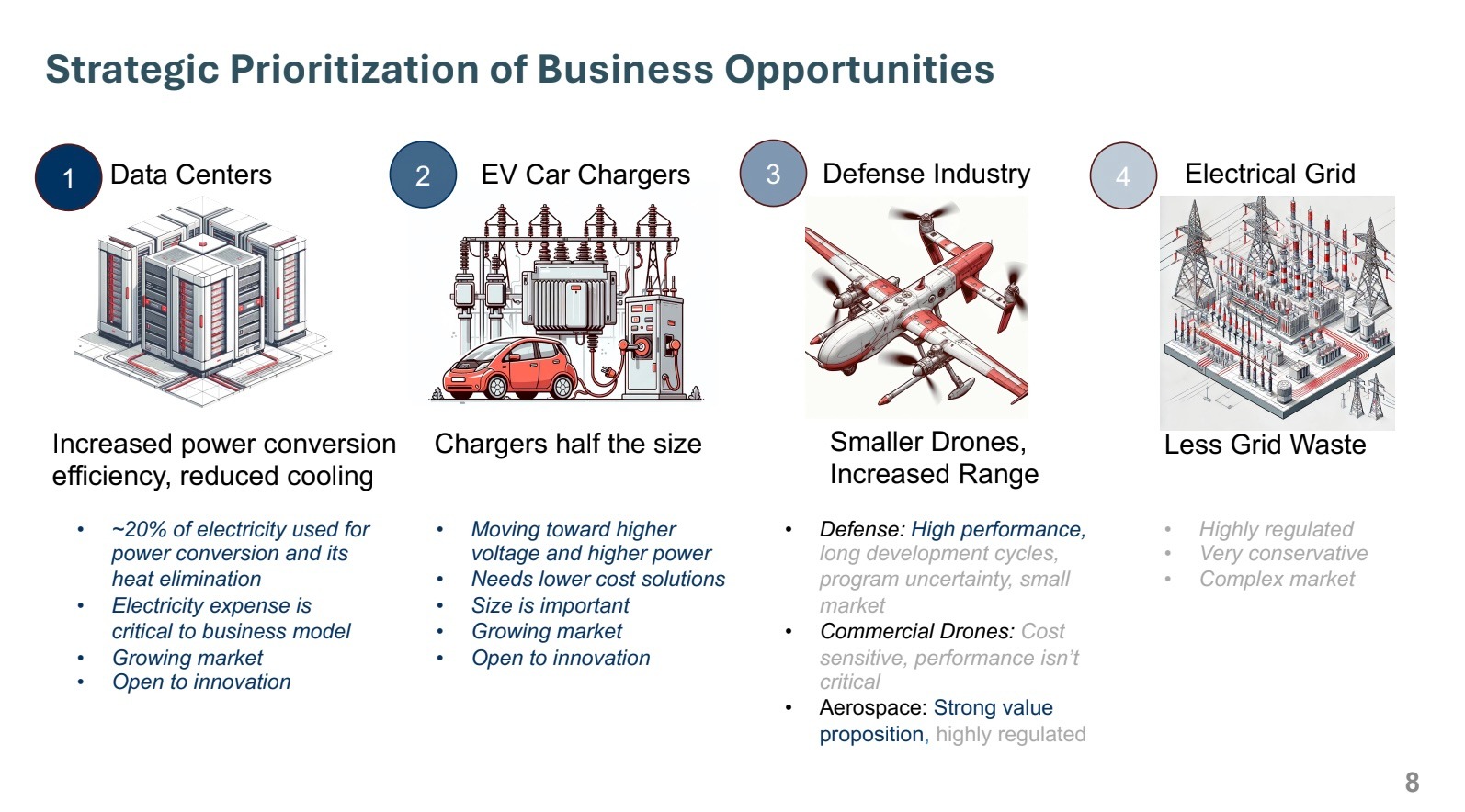
Your GTM slide should detail how you phase your go to market over time with different customer segments, and how you reach them.
What gets VCs excited
- Clear beachhead with a path to a repeatable sales motion
- A path to sales cycle compression (land and expand, ease of GTM following proven efficacy)
- Land-and-expand evidence where initial deployments expand 5-10x within customers
- Multiple paths to customers (direct sales + partnerships) with clear activation plan
- Customer references willing to evangelize and accelerate sales to peers
- Strong understanding of customer buying process and ability to navigate complex enterprise sales
Red flags
- Assuming short sales cycles (3-6 months) without proof
- "We'll sell to everyone" without clear segmentation or sequencing
- Pilots that don't convert to sales (suggests product doesn't deliver ROI)
- Reliance on channel partners without proof of direct sales success first
- No clear path to $100M revenue or math doesn't work (need unrealistic customer counts)
Competition
As markets become crowded, how to create defensibility
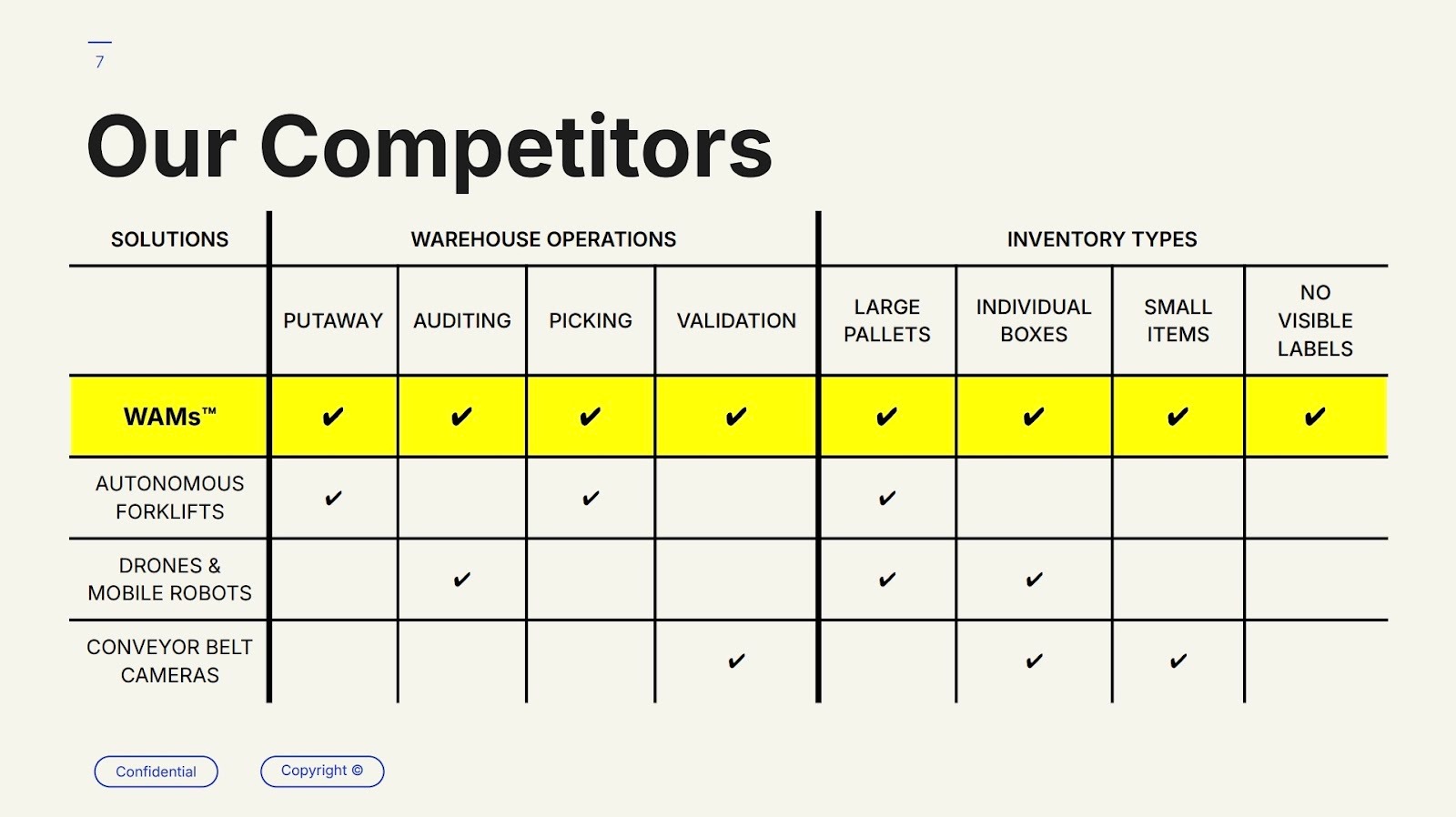
You're competing against: (1) manual labor, (2) traditional fixed automation, (3) other robotics companies, and (4) customers building in-house solutions. Your competitive positioning must address all four.
Common competitive axes for robotics:
- Flexibility vs. Cost: Traditional automation is cheaper but inflexible. You offer adaptability at higher cost. Or you're cheaper than flexible alternatives.
- Performance vs. Ease of Deployment: Some robots do complex tasks but need extensive integration. Others are simple to deploy but limited capability.
- Autonomy vs. Reliability: Highly autonomous systems may have lower reliability. Simpler systems are more reliable but need more human oversight.
- Generalist vs. Specialist: Do you solve one problem exceptionally or many problems adequately?
Tied to competition, is building your argument for long-term defensibility.
Robotics-specific defensibility:
- Fleet data and learning: Your deployed fleet generates data that improves performance. As the fleet grows, you get better faster than competitors can catch up.
- Proprietary hardware/mechanical design: Novel end-effectors, custom actuators, or unique mechanical approaches that are hard to replicate. Must be meaningfully better, not just different. Patent protection helps.
- Software moats: Perception algorithms, motion planning, fleet management software that gets better with deployment. Difficult for others to replicate without your data and deployment experience.
- Integration and ecosystem: Deep integrations with warehouse management systems, ERP systems, or other infrastructure creates switching costs. Network effects if robots work better together.
- Operational excellence and reliability: As you scale, you get better at manufacturing, deployment, and field support. 99.5% uptime is defensible if competitors are at 95%—customers won't switch working systems.
- Brand and customer references: Being the established leader in a category. Customers want proven solutions for mission-critical automation. First-mover advantage can be durable in robotics.
Addressing incumbent risk:
VCs will ask: "Why won't robotics companies in your vertical build this?" Your answer must show:
- Different business model (RaaS vs. CapEx) that incumbents can't/won't pursue
- Technology approach fundamentally different from their legacy systems
- Market segment too small for them but big enough for you (they focus on Fortune 500, you target mid-market)
- Speed and focus advantages (you can iterate faster, they have legacy customers to support)
The strongest defensibility arguments show your solution is directionally impossible or highly unlikely for top incumbents to build themselves. It should be technically novel, challenging to replicate without your team's specific expertise, and protected by IP. Over time, becoming a trusted industry leader and achieving economies of scale creates durable advantages over future competitors.
What gets VCs excited
- Unique technical approach with IP protection (patents filed/granted on core innovations)
- Demonstrable performance advantages (2x faster, 10x more accurate, 50% lower cost) on metrics customers care about
- Data/learning flywheel already showing results (performance improving with fleet deployment)
- Strong head start (18+ months lead on closest competitor) with proof they can't catch up easily
- Market positioning that makes you the obvious choice for a specific segment ("the robot for pharmaceutical manufacturing")
- Customer validation that your differentiators matter ("chose us over competitor X because of Y")
Red flags
- "No competitors" or "we're first" (shows lack of market research—there's always competition)
- Crowded sectors where it can be challenging to discern winners in light of so many similar attempts
- Competitive axes that don't drive purchase decisions ("we use different sensors" when customers care about uptime)
- No clear answer to why big incumbents won't crush you
- Differentiation only in features, not in fundamental approach or business model
- Claiming patent protection on obvious or easily-worked-around innovations
- Multiple well-funded competitors further ahead with similar approaches (suggests you're late)
Team
What makes for a world-class founding team?
At Julian Capital, our deeptech seed fund that invests in many robotics companies, one of the things we care most deeply about is the founding team — more often than not, it’s the deciding factor at the seed stage. We've written about what makes a great founding team here. In short, we're excited by founding teams who are:
- Commercially minded with technical depth
- Building their life's work—the culmination of their career or their final pursuit
- Ambitious enough to scale to $1B+ valuation
- Relentlessly resourceful with high agency
- Persuasive and authentic storytellers
- Comprehensive in thinking through all business avenues (GTM, competitive landscape, bottom-up TAM, etc)
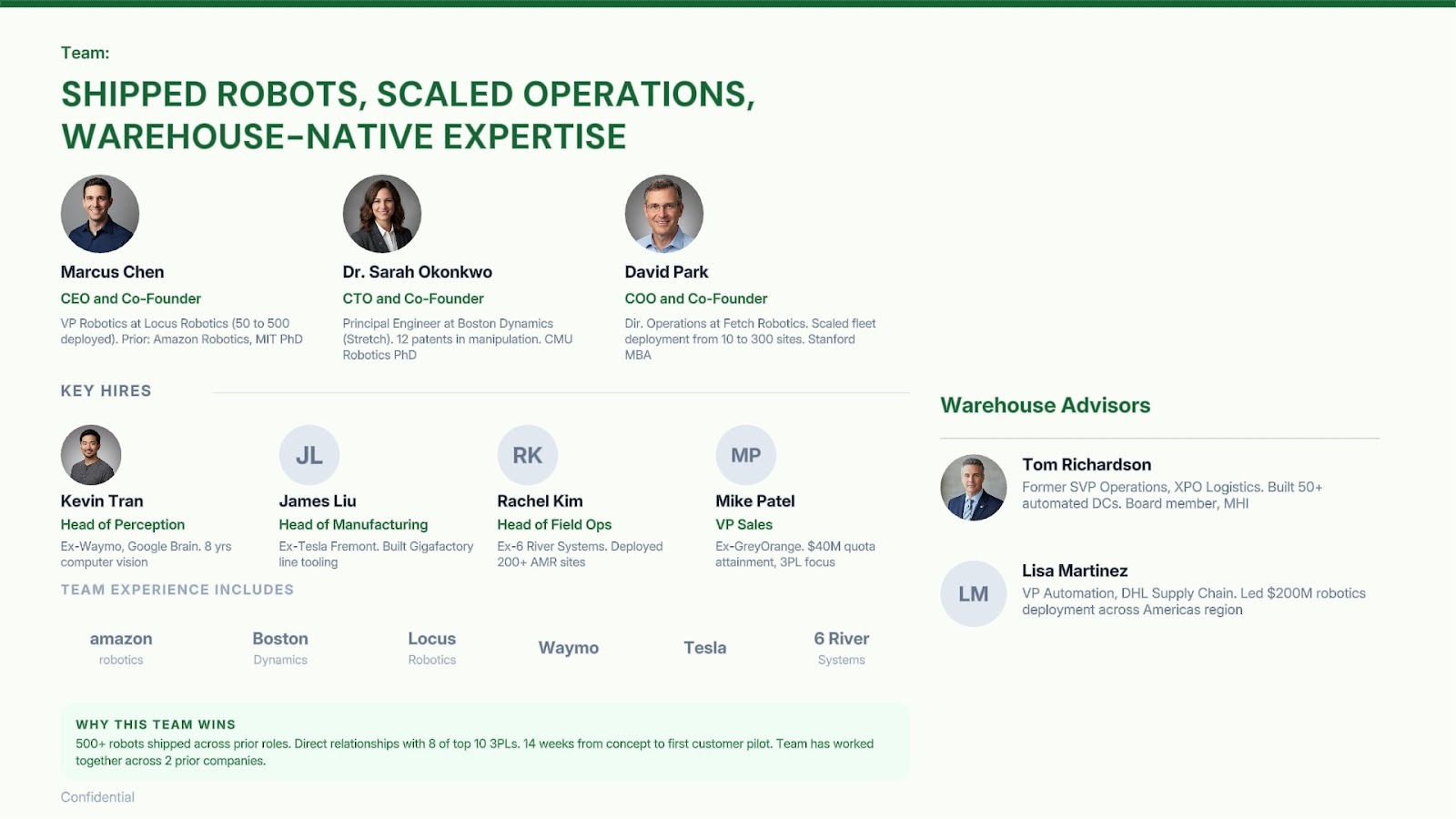
Key skill sets generally include building complex physical systems, selling into enterprise customers, and managing field operations. The strongest robotics founding teams combine:
- Deep robotics expertise: At least one founder with serious robotics background—PhD in robotics, 5+ years at robotics company, or substantial academic research. They need to understand perception, manipulation, controls, and system integration deeply enough to make hard technical tradeoffs.
- Manufacturing/hardware experience: Someone who has shipped physical products before. Understands: design for manufacturing, supply chain, quality control, reliability engineering, field service.
- Domain/industry expertise: Deep understanding of target customer industry. Ideally someone who worked in warehousing, manufacturing, agriculture, etc. They know customer workflows, pain points, buying processes, regulatory requirements. This accelerates sales and prevents building the wrong product.
- Commercial/GTM capability: Someone who can sell and build a business. Doesn't have to be a founder (can hire VP Sales) but the founding team needs commercial orientation.
Your team slide should address the qualities your team has across these dimensions.
What gets VCs excited
- Teams that combine technical depth, manufacturing experience, and commercial orientation
- Founders who have successfully shipped robots or hardware products before (even in prior failed startups)
- Deep domain expertise in target industry with existing customer relationships
- Track record of attracting top engineering talent
- Demonstrated ability to execute quickly (prototype → pilot → deployment in 12-18 months)
- Founders who are mission-driven and committed for the long-term
Red flags
- All-academic teams with no industry or product experience, and no demonstration of the ability to learn key skills to fill in these gaps
- Teams without anyone who has built and manufactured physical products
- Founders who can't articulate clear division of responsibilities or have overlapping roles
- Lack of urgency or treating this as a research project
The Ask:
Use of proceeds and round size
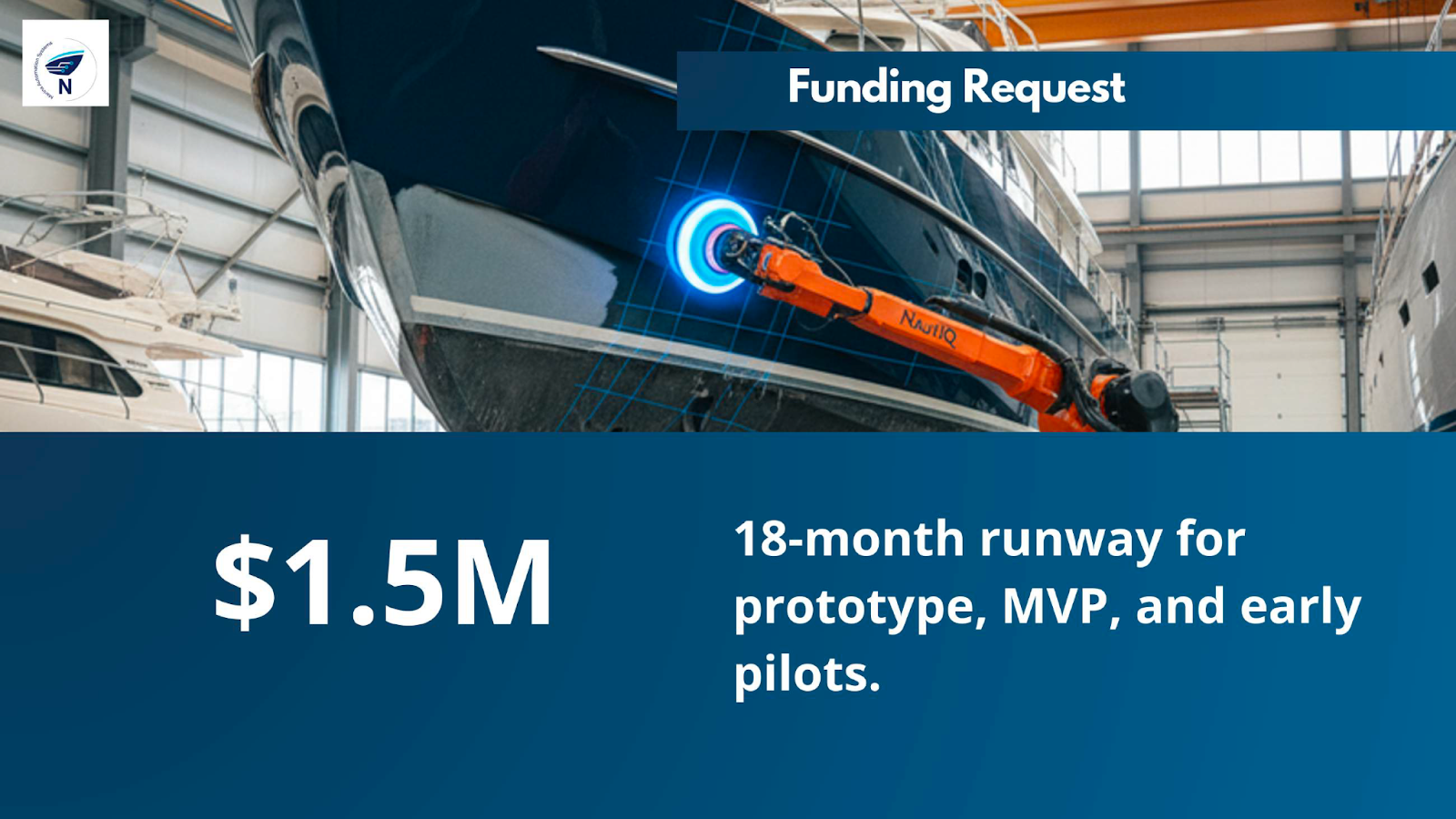
The ask shows how much you are raising and what you plan to accomplish with it. We wrote about choosing how much to raise here.
In robotics, this generally means getting prototypes to production readiness, and deploying initial pilots, with distinct commercial, technical, and manufacturing readiness goals.
What gets VCs excited:
- Raise sized to produce revenue-generating deployments, not just improved prototypes
- Clear bill of materials and manufacturing cost roadmap showing how unit economics improve with volume
- Contracted or committed customer deployments that provide revenue or non-dilutive capital during the round
- Manufacturing partner identified—contract manufacturer or co-manufacturing agreement—to avoid excessive capex
- Use of proceeds that includes field support and iteration budget, not just hardware builds
Red flags:
- Round sized purely for hardware development without a commercial deployment milestone
- No manufacturing cost roadmap
- Underestimating the cost of software development, integration, and field support required to make hardware deployments succeed
- Customer pilots that are free—without some form of economic commitment. These pilots don't validate willingness to pay
- Raise that assumes a single hardware revision will be sufficient
Pitching: Do's & Dont's
Here's how (and how not) to pitch:
The best pitches are conversational. Answers should be succinct yet demonstrate depth of thought.
Great founders bridge vision with detail. They intimately understand their problem space and can explain it clearly—both the problem and the system around it. They understand the path to scale and can map how the business will evolve getting there.
Do:
- Lead with the customer problem, not your technology: Start with "Warehouses lose $2M annually to mis-picks" not "We built a computer vision system."
- Show, don't just tell: Video of your robot working in a real customer facility is worth 10 slides of specifications.
- Be honest about what doesn't work yet: VCs appreciate realism. "Our current system achieves 97% accuracy; we need 99%+ for production" builds more credibility than claiming perfection.
- Have crisp answers on unit economics: You should be able to recite your anticipated COGS, installation costs, service costs, and path to profitability.
- Demonstrate customer intimacy: Drop specific details that show you deeply understand your customer: "The shift supervisor needs approval from facilities, procurement, and IT, which typically takes 6-8 weeks."
- Address the "why now" directly: Robotics has been "5 years away" for 50 years. Proactively explain what's changed that makes your solution viable today.
- Acknowledge and address incumbent risk: Don't wait for VCs to ask "Why won't incumbents in your sector build this?" Address it upfront with a credible answer.
- Bring customer references: Offer to connect VCs with customers who will validate your solution and the problem you're solving. This accelerates due diligence dramatically.
Don’t:
- Don't get lost in technical details: VCs don't need to know your specific ROS packages or control algorithms unless they ask. Focus on what the robot does and why it matters to customers.
- Don't oversell with cherry-picked demos: A single perfect demo run isn't convincing. Show success rates across many attempts or multiple deployment sites.
- Don't claim you can automate everything: Every robotics system has limitations. Be specific about what you can and cannot handle.
- Don't dismiss competition: Acknowledge competitors and explain your differentiation.
- Don't rely on unvalidated assumptions: If you haven't talked to customers about pricing, don't claim "customers will pay $5K/month." Better to say "need to validate pricing" than make up numbers.
We hope this guide was useful to you! If you'd like to get in touch, don't hesitate to reach out to Julian.Capital, Undeterred, AlleyCorp, and apply in <1 minute to get put in touch with thesis fit investors for free at DeepChecks.VC.