Defense Sector: How to Write Your Pitch Deck














Want to know exactly how VCs evaluate your defense startup?
Together with Overmatch—one of the leading defense VCs—we’ve built this guide to unpack the inside baseball on how VCs evaluate defense startups, and in turn how you can raise a successful round.
Informed by reviewing thousands of decks, and insights on which startups get the most traction on Deep Checks, this playbook helps put together a teaser deck that gets your first VC pitch scheduled.
We’ll go slide by slide on how investors decide whether or not to move forward with a startup. It’ll cover:
- Problem: Demonstrating how you’re solving a burning pain point for your customers
- Solution: Show why you have the best solution to this problem
- Traction: How to show there’s demand for your product before the market has adopted it
- Technical risk: How to convince investors to get behind the remaining technical risk that you have
- Business Model: How VCs think about your economics
- Market Size: Why bottom up beats top down
- Go to market: Showing you can become big enough, fast enough
- Why now?: Demonstrating why your startup has just become possible to build. This is make-or-break for many pitches
- Competition: As markets become crowded, how to create defensibility
- Team: What makes for a world-class founding team?
- The Ask: Use of proceeds and round size
- Pitching: Do’s and dont’s of pitching your startup to VCs
Problem
Demonstrating you're solving a real operational pain point for your defense customers
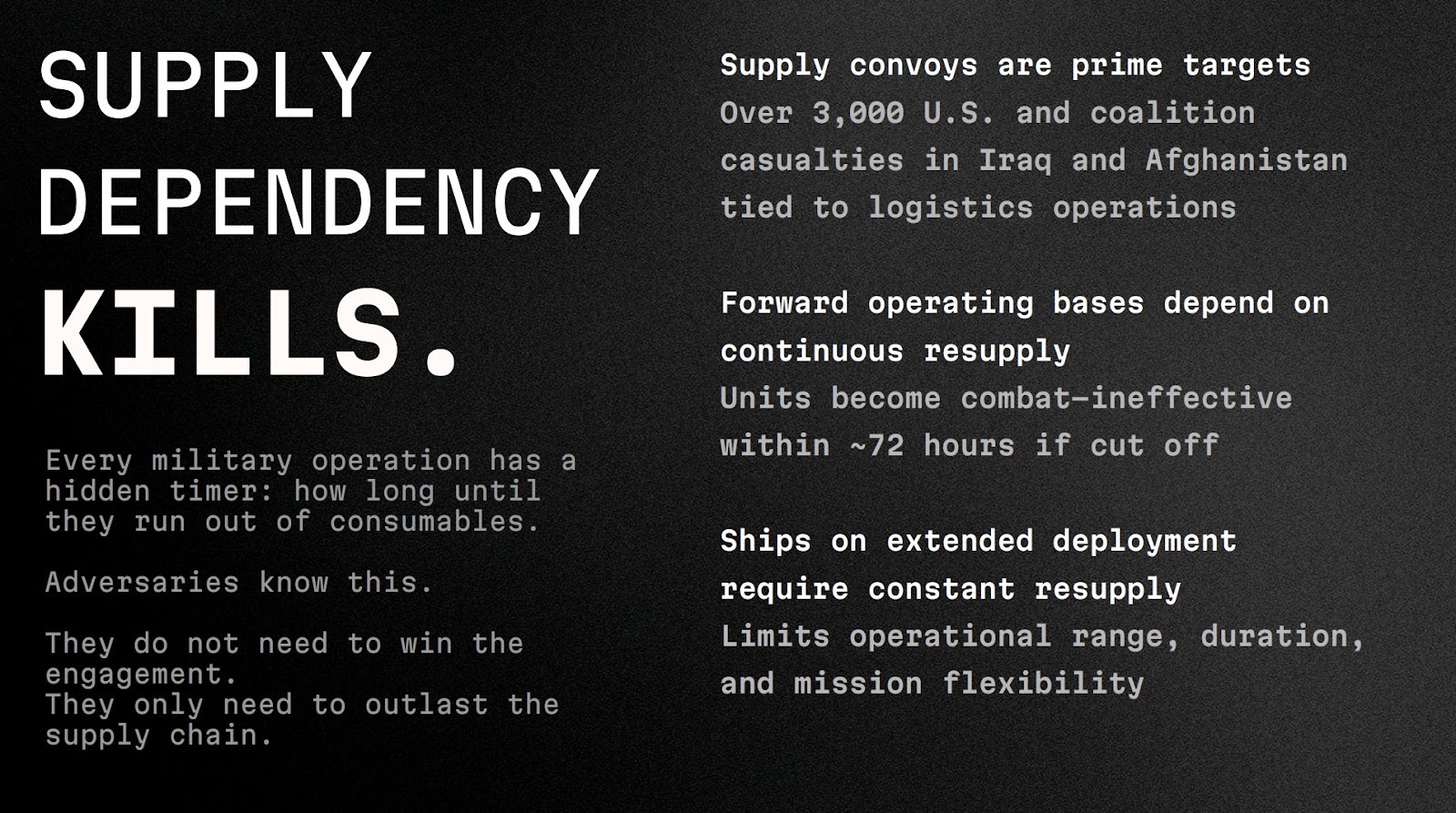
The problem slide exists to convince VCs the pain point you’re solving for your customers is a large, distinct, burning issue that they are willing to endure switching costs to solve.
For defense startups, the challenge isn't proving that defense customers have problems—there are acute capability gaps across every domain. The real question is whether you can identify a specific, funded pain point and show a credible path to getting on contract to solve it.
Defense customers have unique purchase dynamics that make problem framing more complex than in commercial markets.
Multi-stakeholder buying — Defense procurement involves the end user (warfighter or operator), the program office, the contracting officer, and often a prime integrator. A strong problem slide identifies who specifically feels the pain and who controls the budget to fix it.
Interoperability and legacy stack constraints — Your solution must work within an ecosystem of legacy systems, mil-spec hardware, and government-mandated architectures. A software solution needs to understand its accreditation path (ATO), data handling requirements (CUI, ITAR), and how it fits into the existing command structure.
Procurement timelines
How your solution enters the DoW ecosystem—through SBIR, OTA, FAR-based contracts, or a prime teaming arrangement—shapes how you frame the problem's urgency and timeline.
How to show this
In your deck, start with a slide that outlines the general capability gap or operational challenge you're addressing, then follow with a slide on the specific, quantified problem your end customer faces—ideally tied to a funded requirement or documented DoW priority.
What gets VCs excited
- Problems where the operational and economic pain is specific and quantified—cost per mission, readiness degradation rate, incidents per year
- Documented DoW budget line items or NDAA requirements creating funded urgency
- Problems getting structurally worse over time: adversary capability growth, aging infrastructure, expanding attack surface
- Evidence that customers are currently using expensive or inadequate workarounds—improvised solutions, expensive legacy systems, manual processes
- Problems validated directly with operators or program offices, not just inferred from think-tank reports
- Multi-stakeholder pain that spans the warfighter, program manager, and contracting office simultaneously
Red flags
- Problems framed around policy mandates alone without underlying operational drivers
- Technology-first framing ('Our novel edge AI inference engine') rather than customer-outcome framing
- Top down budget claims not tied to distinct problems
- Generic statements about defense modernization without specific customer validation or quantified impact
- Problems that only become relevant at program-of-record scale with no near-term entry point
- Conflating 'the military needs to modernize' with a specific, funded customer pain point
Solution
Show why your solution is the best answer to the problem
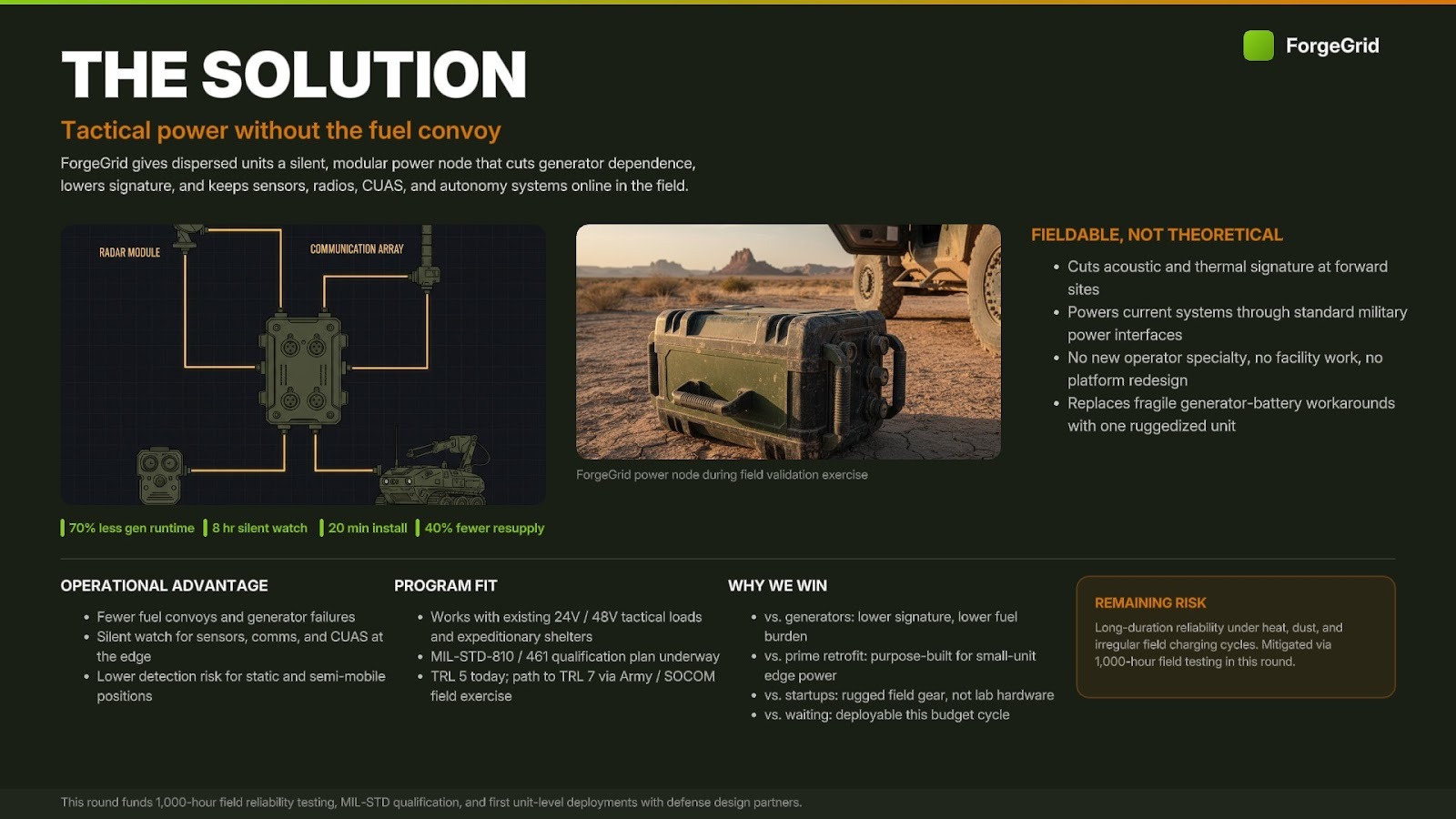
Your solution slide should translate technical capability into the units your defense buyer cares about: SWaP-C (Size, Weight, Power, and Cost), probability of kill or intercept, time-to-deployment, cost per engagement, or reduction in operational risk.
Effective defense solution slides show how your technology translates to operational and program ROI. For example:
- Quantified cost advantage: 'Delivers equivalent protection at 1/8th the SWaP-C of the legacy system, at $280K vs. $2.2M per unit' rather than '12ms latency with 95% detection accuracy.' Translate your specs into the units your buyer uses to make procurement decisions.
- Deployment simplicity: 'Installs in 4 hours using existing ground crew, no facility modifications, qualifies under MIL-STD-461.' Show that your solution fits into existing force structure, training pipelines, and logistics chains.
- TRL and acquisition pathway: 'Currently TRL 5, path to TRL 7 via JIDA OTA in Q3 2026.' DoW customers think in TRLs—show you speak their language and have a credible qualification roadmap.
- Interoperability: 'Open-architecture, JADC2-compatible, meets DISA STIG requirements.' Show you've thought through the integration challenge, not just the technical problem.
For defense, the solution must address why your approach is better than: (1) the incumbent system the DoW already owns and has sunk cost in, (2) what a prime integrator could build by modifying an existing product, (3) other venture-backed companies in your category, and (4) waiting for a DARPA or Service lab program to deliver.
Your solution slide should address the specific operational need you’re addressing, and imply why it’s better to alternatives or existing solutions.
What gets VCs excited
- Clear cost or performance advantage over the incumbent improvement on the metrics program offices actually use to evaluate alternatives
- TRL pathway clearly stated with identified test events, government facilities, or co-development partners
- Solutions that address multiple value streams—primary mission capability plus sustainment cost reduction, training applications, or allied partner sales
- Open-architecture design compatible with existing DoW platform standards
- Dual-use angle that generates commercial revenue while defense qualification proceeds
Red flags
- Leading with technical specifications absent showing operational or program value
- TRL claims not supported by test data or credible validation evidence
- Comparing only to legacy systems without addressing why a prime couldn't build this with a product modification
- Assuming perfect policy environments or full program-of-record adoption as the baseline scenario
- No discussion of MIL-SPEC qualification, ATO path, or ITAR compliance
Traction
How to show there's demand for your product before the market has adopted it
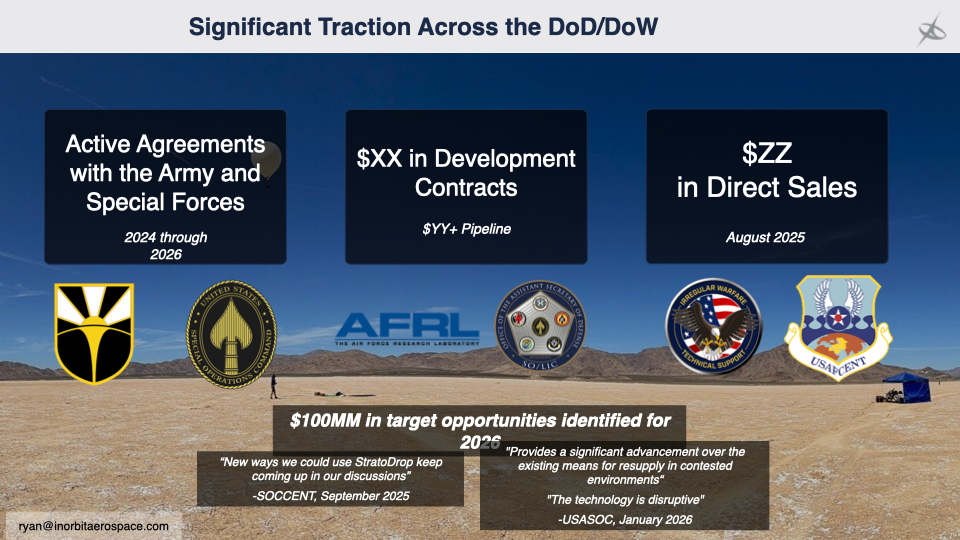
In defense, traction looks different from commercial markets. A SBIR Phase II award worth $1.5M is more meaningful than 20 commercial LOIs. Understanding what each signal actually means is your job as a founder.
In order of most to least convincing, there are four ways you can demonstrate traction to defense VCs:
OTA prototype agreements and SBIR Phase II awards: These are the clearest early-stage government validation signals available. A Phase II SBIR indicates a program office believes your approach has technical merit and operational relevance. An OTA prototype agreement shows a contracting officer was willing to put money behind your company specifically. Having a transition pathway and internal champion that help you move beyond SBIRs go even further.
Paid pilots and deployed systems: Solution operating at a customer site, aboard a platform, or in an operationally representative environment. Even better if the government is paying—even at subsidized rates—and generating independent performance data. Similar stage progress includes a Phase 1 SBIR, which holds less weight than Phase 2.
Teaming agreements with prime integrators: A signed teaming agreement with Lockheed, Raytheon, L3Harris, Northrop, or SAIC shows you've passed a vetting process. Primes don't team with companies they don't believe in—they have existing program relationships to protect.
Customer discovery depth: For pre-product companies, show 30–50+ structured conversations with military operators, program managers, and contracting officers. Document specific requirements, budget cycles, competitive alternatives, and decision-making processes. Include: Who is the economic buyer vs. the technical evaluator? What is the approval process? What capability threshold triggers a procurement decision?
Your traction slide should demonstrate how far along this spectrum you've gotten. At minimum for the seed stage, investors will generally want to see a functional prototype, and a SBIR Phase I award or equivalent government validation.
What gets VCs excited
- SBIR Phase II, OTA prototype agreement, or DIU commercial solutions opening—shows government is putting money behind your approach
- Named program offices that have facilitated introductions, site access, data sharing, or test range access
- Customers paying something—even subsidized rates—for pilots or prototype evaluations
- Government grant funding (SBIR, STTR, AFWERX, NavalX, DIU) alongside commercial or allied partner traction
- Evidence of expanding scope: program offices requesting additional capability, larger systems, or multi-site evaluations
Red flags
- Letters of support from military officers who don't control procurement budgets or acquisition authority
- SBIR Phase I only, with no Phase II path and no other contract revenue
- LOIs from defense primes without a funded teaming scope or specific program capture
- Pilots where the government paid nothing, committed nothing, and generated no independent performance data
Technical Risk
How to convince investors to get behind your remaining technical risk
Defense-tech venture investors, like all deep-tech investors, accept engineering risk (technically feasible work using known methods) but not scientific risk (your solution requires breakthroughs that may not come). Early-stage VCs want to know:
- What has been proven
- What needs to be proven (across technical efficacy, system performance, qualification, and scale-up)
- Why you are confident you will achieve this—and on what timeline
In defense specifically, technical risk has dimensions that don't appear in commercial deep-tech. Investors will want to talk through:
- Adversarial robustness: Will your system still perform when a sophisticated adversary is actively trying to defeat, jam, spoof, or evade it? This is the question that separates commercial-grade from defense-grade.
- Environmental hardening: MIL-SPEC qualification (MIL-STD-810, MIL-STD-461, MIL-STD-1275) is genuinely difficult, expensive, and time-consuming. Map the qualification path with a realistic timeline and cost estimate.
- System integration risk: Legacy military systems have notoriously poor interoperability. Connecting to DoW infrastructure—networks, platforms, ground systems—requires navigating government-mandated architectures and lengthy accreditation processes.
- Manufacturing and scale-up risk: Can your technology be manufactured at the cost, quality, and security requirements of a defense supplier? ITAR-compliant supply chains add complexity beyond commercial manufacturing.
- Durability and reliability: Military systems operate in extreme environments over long service lives. Will your technology perform reliably over 10–20+ year operational lifetimes?
- Permitting and certification: What certifications (ATO, UL, DO-178C for aviation software, UL 2900 for cyber) do your customers require, and what gives you confidence in your path to securing them?
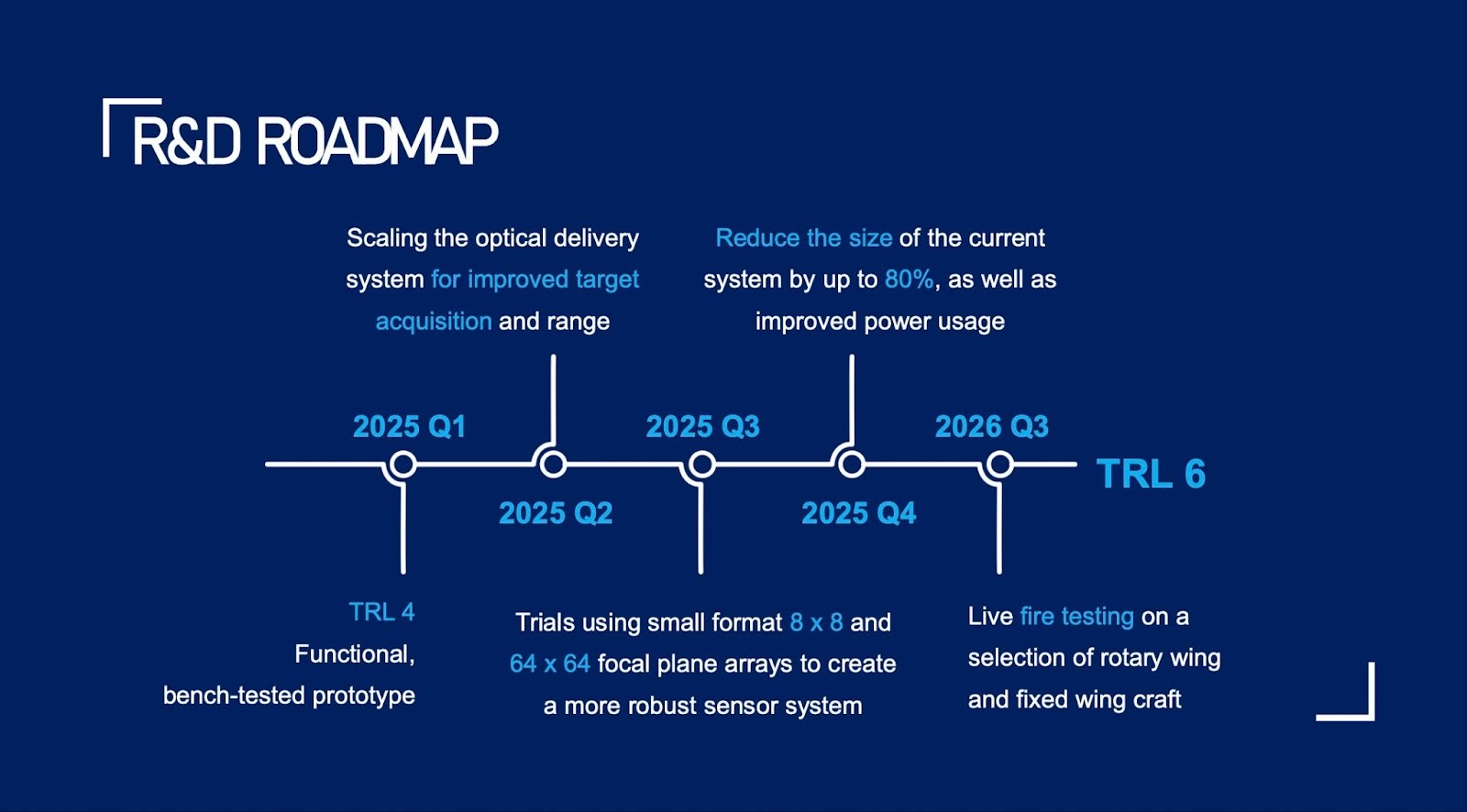
The technical risk slide won't cover all of this, but you can lay a strong baseline with a TRL visualization, a milestone roadmap tied to funding tranches, and evidence of your current validated performance. A strong pathway outlines the development path from lab bench to first operational system: cell-level validation, system assembly, government test range evaluation, and pilot deployment—with cost and timeline at each stage.
Have a clear roadmap for the phase of each product, and how it applies to the markets you will target over time. The technical risk story line should intertwine with the narrative on your long term vision, and how early markets map to longer term opportunities.
What gets VCs excited
- TRL clearly stated with test data or government-validated evidence supporting the claimed level
- Clear delineation between engineering risk (solvable with known methods) and scientific risk—with remaining risk firmly in the engineering category
- Adversarial robustness addressed: red team testing, jamming resistance, cyber hardening, spoofing resistance
- Named government test ranges, facilities, or co-development partners for next TRL milestone
- Credible MIL-SPEC qualification roadmap with timeline and cost estimate
- Proprietary technical insights or IP that provide a fundamental performance advantage
Red flags
- TRL claims without supporting test data, third-party evaluation, or government-recognized validation
- No discussion of adversarial operating conditions—system only tested in benign lab environments
- Core technology relying on AI/ML models with no discussion of performance in denied, degraded, or contested environments
- Scale-up plans that skip intermediate steps—from lab bench directly to program-of-record production
- Unrealistic MIL-SPEC qualification timelines that don't account for iterative test-fail-fix cycles
- No discussion of ITAR-compliant supply chain requirements for defense-grade manufacturing
Business Model
How VCs think about your economics: contract vehicles, program finance, and capital structure
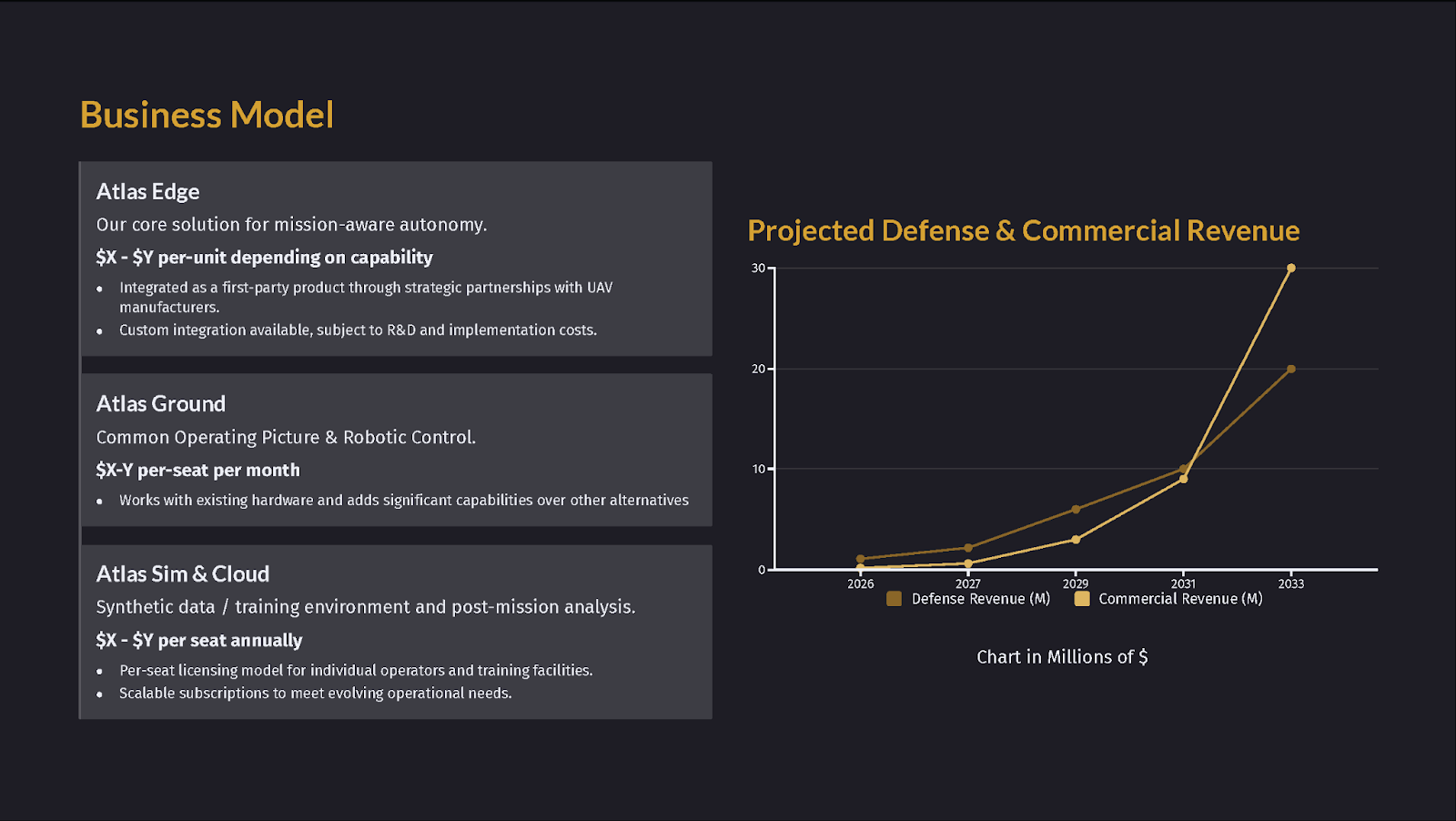
Your business model slide should include the basics of how you get on contract, the high-level economics from first dollar to production scale, and the margin you can achieve at each stage.
Revenue in defense comes through government contracts—SBIR awards, OTA prototype agreements, FAR-based contracts, and eventually program-of-record production contracts. Showing you understand the progression from cost-plus development funding to fixed-price production economics is as important as showing your gross margin.
When diving deeper in your pitch, VCs want to understand:
- Your contract vehicle path today: SBIR, OTA, FAR-based contract, or prime subcontract—and what that means for your revenue recognition and margin
- Your projected economics at production scale—and what needs to happen to get from current prototype costs to commercially viable margins
- How you will fund hardware development and production scaling (equipment finance, DoW loan programs, project finance) and how these limit dilution over time
For dual-use companies: Show how commercial revenue funds development while defense qualification proceeds. The commercial timeline should generate real operating data, reduce technical risk, and provide a revenue backstop if defense procurement timelines slip.
What gets VCs excited
- Clear progression: SBIR/OTA funding → prototype contract → small scale production → full-rate production, with realistic timeline and economics at each stage
- Dual-use structure where commercial revenue de-risks the government timeline
- Unit economics at production scale showing 30–40%+ gross margin
- Recurring revenue component: sustainment contracts, software subscriptions, training services, or data licensing
- Program of record adjacency—your solution addresses a funded, growing budget line item
- Understanding of how non-dilutive government funding (SBIR, STTR, DoW OTA, DoE loans) limits equity dilution during hardware development
Red flags
- Revenue model entirely dependent on a single program that hasn't received full multi-year funding
- Gross margins below 30% even at full production scale
- Business model entirely dependent on a single NDAA mandate or policy incentive that could be modified or repealed
Market Size
Why bottom-up beats top-down—even in defense
Your market sizing slide should be broken down into your:
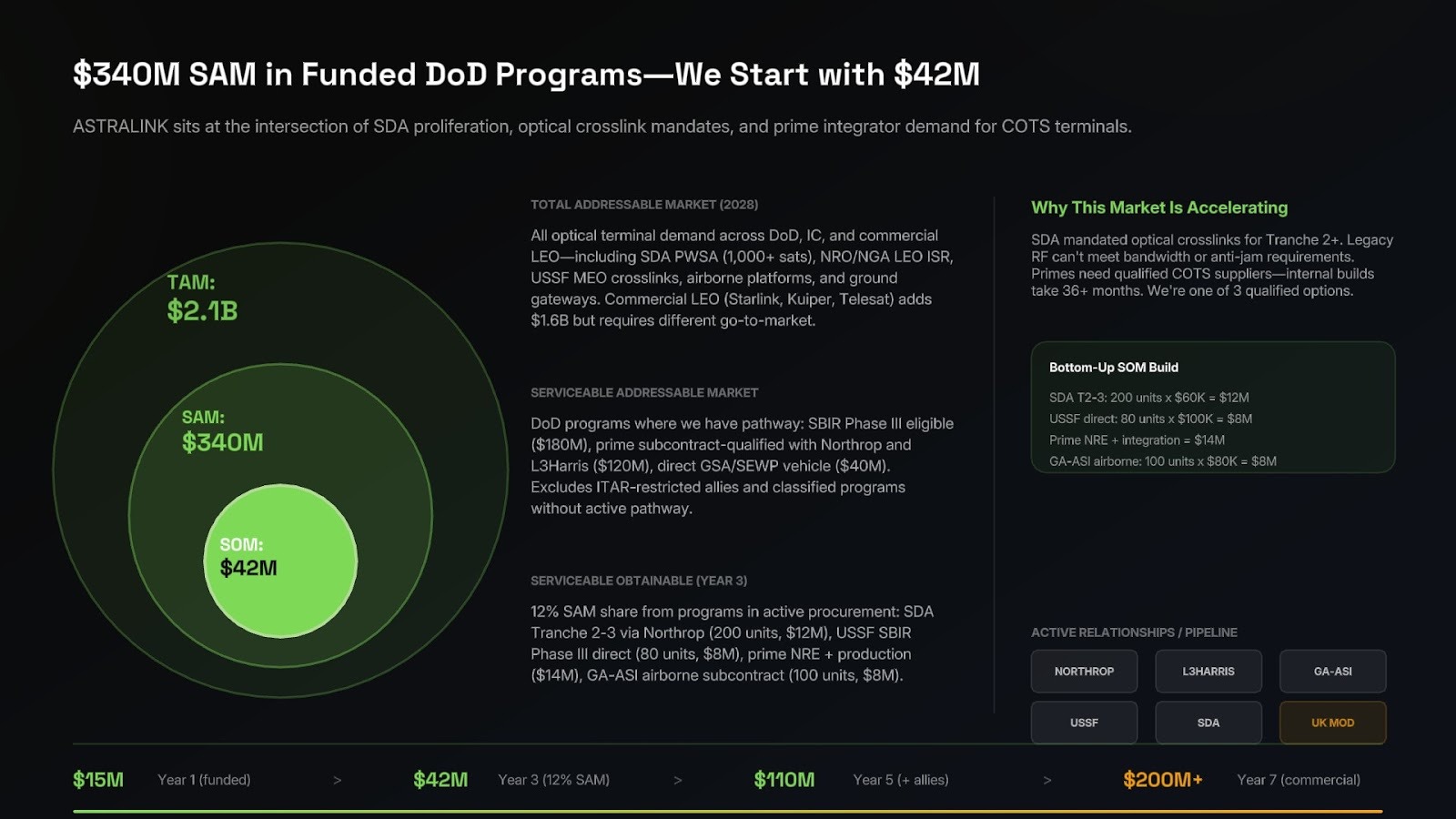
Total Addressable Market (TAM) — The total revenue opportunity if you achieved 100% market share across all potential customers. In defense: identify the program elements and budget line items in the President's Budget that fund capabilities in your domain. These are public. Total potential platforms or installations × annual revenue per customer.
Serviceable Addressable Market (SAM) — The portion of TAM you can realistically reach given your contract vehicle strategy, clearance requirements, geographic focus, and current capabilities. Customers matching your target profile and procurement pathway × annual revenue per customer.
Serviceable Obtainable Market (SOM) — The market share you can realistically capture in the next 1–3 years, accounting for competition, procurement timelines, and resources. SAM × realistic market share % over the next few years.
This method is strongly preferred over 'top down' market sizing, where you infer total demand based on the overall defense budget. VCs want to understand how large your specific business can get—the total defense budget might be $900B, but if your solution addresses one program element with $1.2B in annual procurement, your accessible market starts there.
A bottom up market sizing segmented by your target markets or relevant programs builds strong credibility.
What gets VCs excited
- Bottom-up TAM built from public DoW budget documents—program elements, budget line items, platform counts
- Named procurement competitions, NDAA requirements, or funded capability gaps that anchor your SOM
- TAM >$5B with a credible path to $100M+ revenue in 5-7 years
- International allied markets adding realistic TAM expansion with a clear export control pathway
- Market growth driven by structural forces—adversary capability development, platform recapitalization cycles—rather than cyclical defense spending
- Platform potential: initial application opens adjacent programs or allied customer segments
Red flags
- Top-down market sizing using total DoW budget as a proxy—'the defense market is $900B'
- No reference to specific program elements, budget line items, or named procurement competitions
- TAM that requires selling to every branch simultaneously with no beachhead strategy
- International market included without acknowledging ITAR/EAR export control implications
- Market projections not grounded in identifiable procurement competitions, platform counts, or program office budgets
Go to Market
Showing you can navigate defense procurement to reach venture-scale revenue
Within the pitch, the most important question to answer is how your GTM motion can support venture-scale revenue—typically $100M+—within the 5-7 year timeframe of a venture fund. VCs will use this slide to assess your depth of knowledge on defense procurement dynamics and customer purchasing behavior.
Defense GTM is not a sales funnel—it is a relationship network. Program manager relationships, contracting officer trust, prime integrator partnerships, and government innovation hub engagement determine whether you get on contract. Warm introductions from the right people can compress years into months.
VCs will want to understand
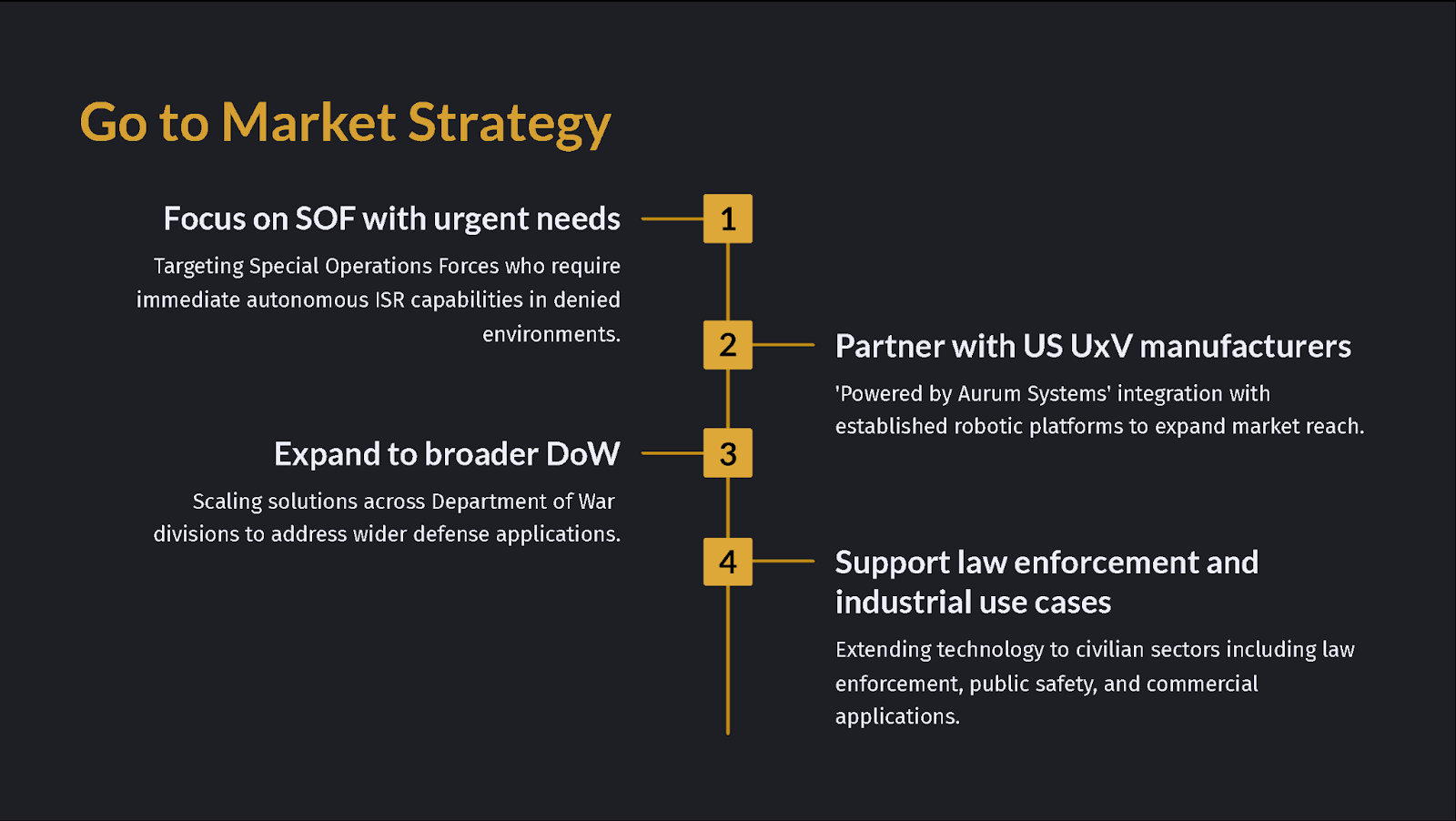
Contract vehicle strategy and sequencing: Start with the contract vehicle most accessible to a non-traditional vendor at your stage—typically SBIR/STTR, an AFWERX or DIU Accelerator, or an OTA prototype agreement. Map how you move from initial contract to more mature contracts.
Beachhead customer and expansion path: Which specific command, program office, or platform is your entry point? How do you move from one branch to all services? What proof points does a Navy program office need to see before following an Air Force early adoption? What does the allied partner expansion path look like, and what ITAR licensing is required?
Prime integrator strategy: Primes are simultaneously your biggest channel partners and your most dangerous potential competitors. Show that you have a clear strategy: are you a complement to the prime's existing product line (and therefore a teaming partner), or a direct replacement (requiring a different path to market)?
Your GTM slide should lay out the path within this as relevant to your company.
What gets VCs excited
- Named program office champions who have actively facilitated introductions, data sharing, or test access
- Clear beachhead—specific command, platform, or program office—with a credible expansion sequence
- Teaming agreement with a prime that has existing capture on a relevant program re-compete
- DIU, AFWERX, NavalX, or Army Futures Command accelerator engagement with funded project status
- Advisory board with former PEO-level, ACAT program manager, or senior acquisition official experience
- Commercial traction that directly maps to defense requirements and generates credible performance data
Red flags
- GTM slide that says 'sell to the DoW' with no program-specific strategy, no named beachhead, and no contract vehicle path
- No named relationships with program offices, prime BD teams, or government innovation hubs
- Assuming a sole-source contract is achievable from a cold start with no pre-existing program relationship
- International sales listed without acknowledging ITAR/EAR export control requirements and licensing timelines
- GTM timeline that doesn't account for 12–18 month DoW program planning and budget cycles
- Ignoring the role of prime integrators as gatekeepers and channel partners in defense sales
Why Now
Demonstrating why your startup has just become possible to build
Many defense technology ideas have been attempted before. The DoW has known it needed better electronic warfare, better autonomous systems, better predictive maintenance—for decades. After addressing technical risk, explain what specifically changed to make your startup uniquely possible now—and why the window is open today rather than five years ago or five years from now.
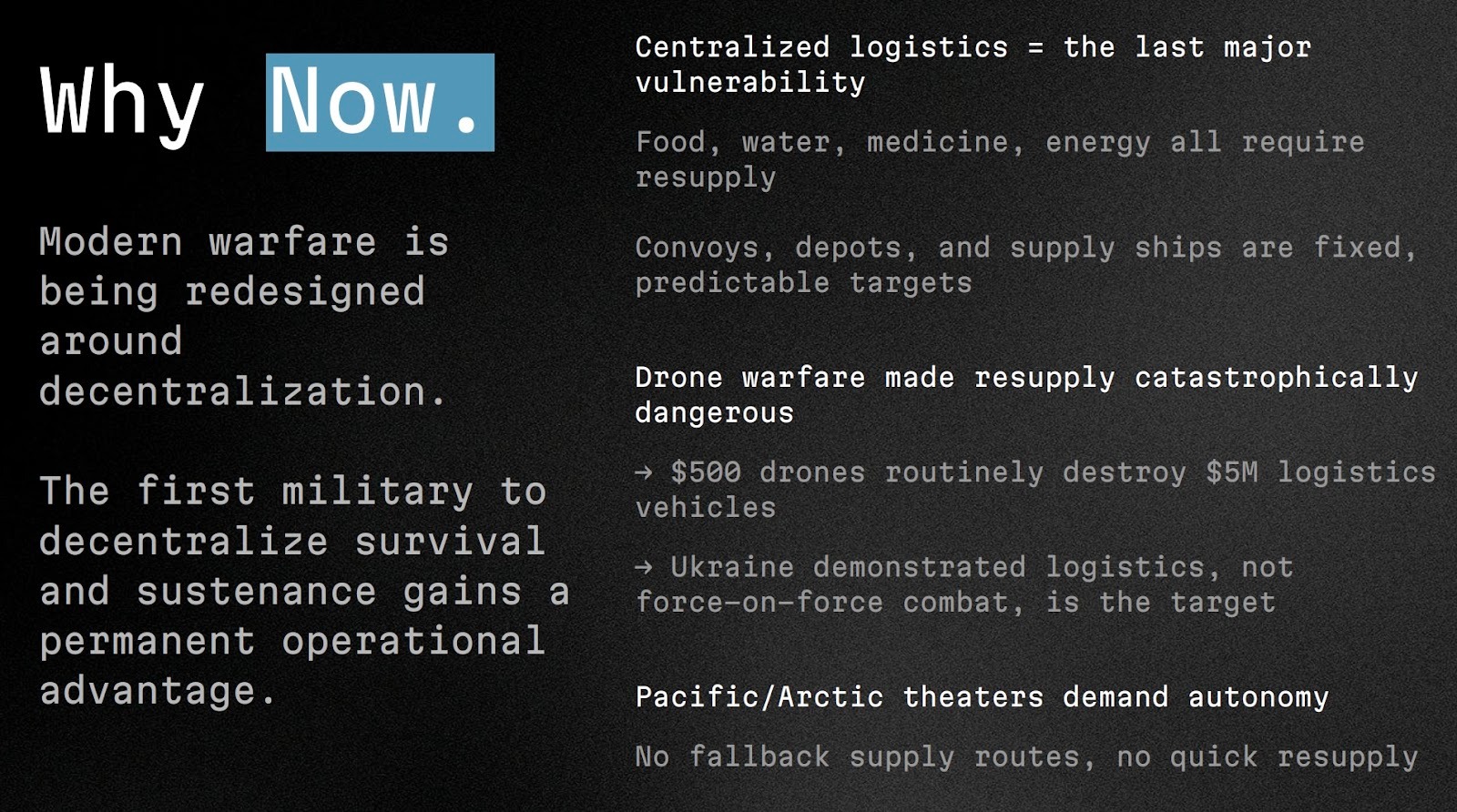
Inflection points across technology cost, threat environment, procurement culture, or policy create compelling narratives for why your startup is timely. Here are the inflection points we're seeing in 2026:
Threat environment: The Ukraine conflict demonstrated at scale the decisive operational role of low-cost autonomous systems, commercial ISR, and electronic warfare—accelerating DoW urgency around capabilities that were theoretical priorities two years ago. Adversary hypersonic and directed-energy investments have created funded urgency in response domains.
Technology cost: Commercial FMCW radar costs have fallen 85%+ since 2020. Foundation model inference costs have fallen 99%+ since 2022. Solid-state battery energy density has crossed military threshold requirements. These cost collapses make solutions viable that were previously cost-prohibitive at military quantities.
Procurement culture: The OTA reform of 2016, Section 804 of the FY16 NDAA, the Defense Innovation Unit's commercial solutions openings, and the CDAO's AI Rapid Capabilities Cell have genuinely opened procurement pathways that did not exist before. Non-traditional vendors can now get on contract faster than at any point in modern defense history.
Budget environment: Specific funded program elements—LIDS for counter-UAS, JADC2 integration funding, DIU commercial solution openings for AI-enabled ISR—have created explicit, funded demand for commercial technology in categories where DoW previously relied on primes.
Describing what inflection points make your business uniquely possible today shows investors why you're positioned to bring your idea to market now. The strongest 'why now' answers also explain why previous attempts at your problem failed, and why your approach avoids those failure modes.
What gets VCs excited
- Specific, quantified changes in enabling conditions—'FMCW radar costs fell below $12K per unit, making our system economics viable at military quantities for the first time'
- Named DoW budget line items or NDAA requirements creating funded, urgent pull
- Confluence of multiple trends making your solution newly viable: technology cost + procurement pathway + threat environment
- Recent failure of competing approaches that validates your different method—canceled DARPA program, failed prime prototype, or abandoned acquisition strategy
- Evidence that buyer willingness-to-adopt has shifted—'Two years ago, program offices wanted to study this. Now they're issuing OTA solicitations with delivery timelines'
Red flags
- Generic claims about 'the defense modernization imperative' without showing what specifically changed
- 'Why now' arguments based on hypothetical future threats or technology milestones that haven't occurred
- Ignoring why previous DARPA programs or defense startups didn't solve this problem
- Budget optimism: citing the defense topline without identifying specific funded requirements
- Policy-only argument: 'The NDAA mandates this' without showing the procurement mechanism and budget already exist
- Over-reliance on a single policy incentive that could be modified or repealed without showing the economics work independently
Competition
Creating defensibility in a market with entrenched primes and well-funded startups
Defense's massive addressable market can support multiple venture-scale outcomes. The concern is whether competitive pressure from entrenched primes will crowd out your sales, erode your pricing, or—worse—cause a program office to simply wait for a prime to build a version of your product.
Put simply: when competing head-to-head for a program, do you have good reason to win? Can you demonstrate a path to becoming a trusted, qualified supplier—or to achieving enough sole-source characteristics to protect your program relationships over time?
Defense competition is multi-dimensional. You're competing against: (1) legacy systems the DoW already owns and has sunk cost in, (2) what a prime integrator could build by modifying an existing product, (3) other venture-backed startups and neo-primes in your category, and (4) the customer choosing to wait for a DARPA program to deliver. Your competitive positioning must address all four.
Addressing the prime integrator risk
VCs will ask: 'Why won't Raytheon / Northrop / L3Harris / SAIC build this?' Your answer must be specific. Generic answers ('they're too slow') will not satisfy a defense-savvy investor. The best answers show that the primes are structurally incapable of your approach—different manufacturing model, different cost structure, a business model that would cannibalize their existing revenue, or a market segment they explicitly don't serve.
Tied to competitive advantage today, is how you maintain defensibility over time.
Defensibility in defense tech can emerge from
- Proprietary technology and IP: Novel hardware architectures, manufacturing processes, or algorithmic approaches protected by patents. In defense, trade secrets and classification can also protect IP.
- Qualification record and operational track record: Every TRL milestone achieved, every test event passed, every MIL-SPEC certification earned builds a qualification record that competitors have to replicate from scratch. This takes years.
- Sole-source justification: A combination of unique qualifications, classified performance data, and program office relationships can create conditions where your solution is the only qualified alternative for a specific requirement.
- Supply chain and manufacturing exclusivity: Defense-grade supply chain relationships, ITAR-compliant manufacturing partnerships, or exclusive access to critical materials can limit competitor access.
- Speed and iteration advantage: Demonstrably faster from new requirement to fielded capability—especially in domains where adversary threats are evolving quickly.
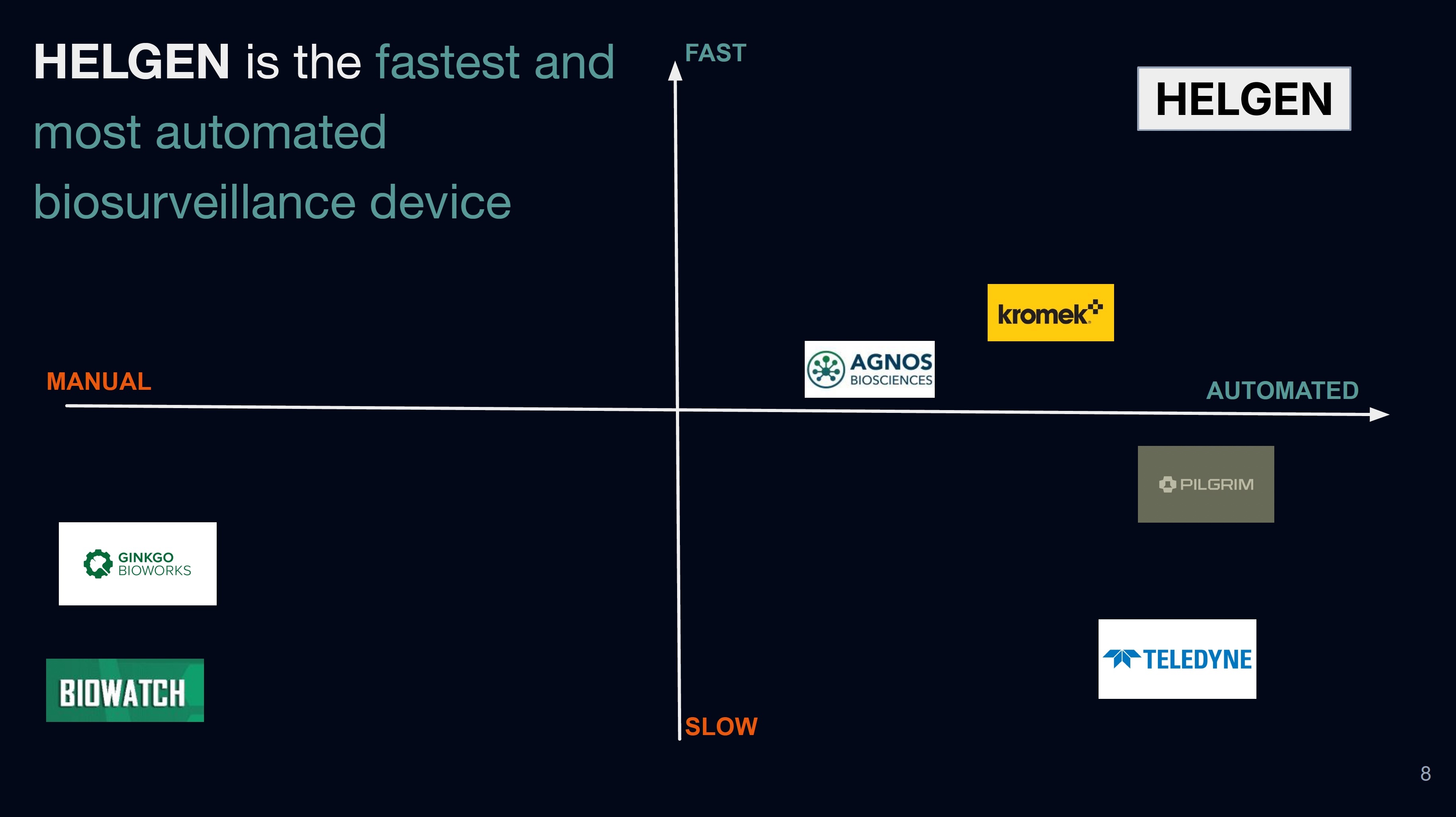
Your competition slide should address how you are superior to incumbents and other emerging technologies.
What gets VCs excited
- Technical approach fundamentally different from prime product roadmaps—not incremental improvement on an existing line item
- Qualification record being systematically built: TRL milestones, MIL-SPEC certifications, test range results
- Clear answer to why the primes can't or won't build this: different manufacturing model, incompatible business model, market segment they don't serve
- Open-architecture design that makes you a complement rather than a threat to prime integrators
- Customer validation that your differentiators matter—'chose us over the incumbent specifically because of Y'
Red flags
- 'No competitors' or 'we're first'—there is always competition, even if it's the status quo or a DARPA program
- Competitive axes that don't drive program office decisions—'we use a different approach' when customers care about qualification status and delivery timeline
- No credible answer to why Raytheon / Northrop / L3 / SAIC won't build a competitive response to a funded program
- Competitive landscape that omits DARPA programs, Service lab efforts, or allied nation solutions in your domain
- Multiple well-funded startups with more operational history, more government contracts, and more advanced qualification status in your category
Team
What makes for a world-class defense founding team
At Julian Capital, we’ve written about what makes a great founding team here. We're excited by founding teams who are:
- Commercially minded with technical depth
- Building their life's work—the culmination of their career or their final pursuit
- Ambitious enough to scale to $1B+ valuation
- Relentlessly resourceful with high agency
- Persuasive and authentic storytellers
- Comprehensive in thinking through all business avenues (GTM, competitive landscape, bottom-up TAM, etc)
Defense founders come from diverse backgrounds—veterans, aerospace engineers, intelligence community alumni, academic researchers, and prior founders. The common thread among great defense founders is understanding that procurement, regulatory, and commercial challenges matter as much as technical ones—and building teams capable of navigating all three.
The ideal defense founding team has three distinct profiles working together: deep technical capability in the relevant domain, defense acquisition and procurement fluency, and operational credibility with the end customer. Few founding teams have all three—but the best ones know exactly what they're missing and have a credible plan to fill the gap.
Within defense particularly, these qualities matter
- Deep technical expertise: At least one founder with the technical depth to navigate the domain from lab prototype through MIL-SPEC qualification. Understands the engineering and scientific fundamentals deeply enough to lead hiring and make credible trade-off decisions under program pressure.
- Manufacturing or deployment experience: Someone who has built and shipped hardware—understands design for manufacturing, defense-qualified supply chain management, quality control at volume, field commissioning, and what goes wrong between prototype and production.
- Defense acquisition or BD experience: Deep understanding of how DoW buys: program office dynamics, the FAR/DFARS framework, OTA authorities, SBIR/STTR mechanics, and prime teaming relationships. Knows the language of procurement and the relationships that open doors.
- Operational military credibility: Experience in the relevant operational domain—either as a former warfighter who used systems like yours, or as a researcher or engineer embedded in operational units. The customer trusts that you understand the mission.
- ITAR and regulatory fluency: A team that has thought through ITAR, EAR, facility clearance requirements, and DSS compliance from day one signals seriousness. A team that discovers ITAR at Series A has a material problem.
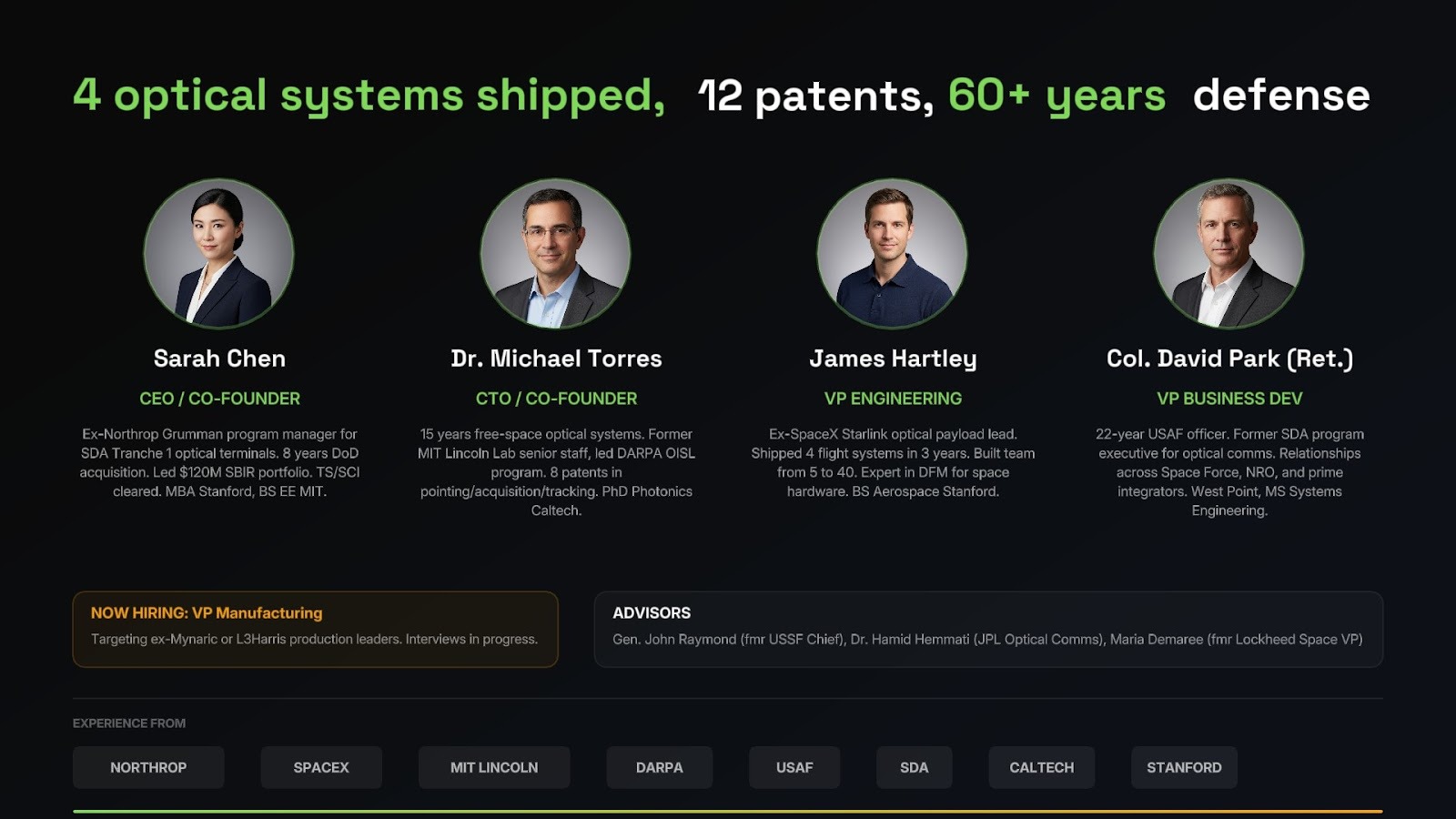
Your team slide should demonstrate your expertise across these domains.
What gets VCs excited
- Teams that combine deep technical expertise, hardware manufacturing experience, defense acquisition fluency, and operational credibility
- Founders who have successfully built and deployed defense or hardware systems before—even in prior companies or government roles
- Existing relationships with target program offices, commands, or prime integrators at the decision-maker level
- Security clearances held by key team members, or a credible documented path to obtaining required clearances
- ITAR compliance plan already underway—facility clearance strategy defined from the start
- Mission-driven founders with a long-term commitment
Red flags
- All-PhD team with zero government procurement or operational experience and no plan to hire it
- Military service listed as a credential without any procurement, acquisition, or technical relevance to the specific problem
- No evidence the team has spent meaningful time with actual military customers in their operational environment
- Founders who can't articulate the difference between an OTA, a SBIR Phase II, and a FAR-based contract
- ITAR never mentioned—suggests the team hasn't worked through the compliance requirements that govern their product
- Pure software engineers trying to build complex defense hardware with no hardware co-founder and no credible plan to hire one
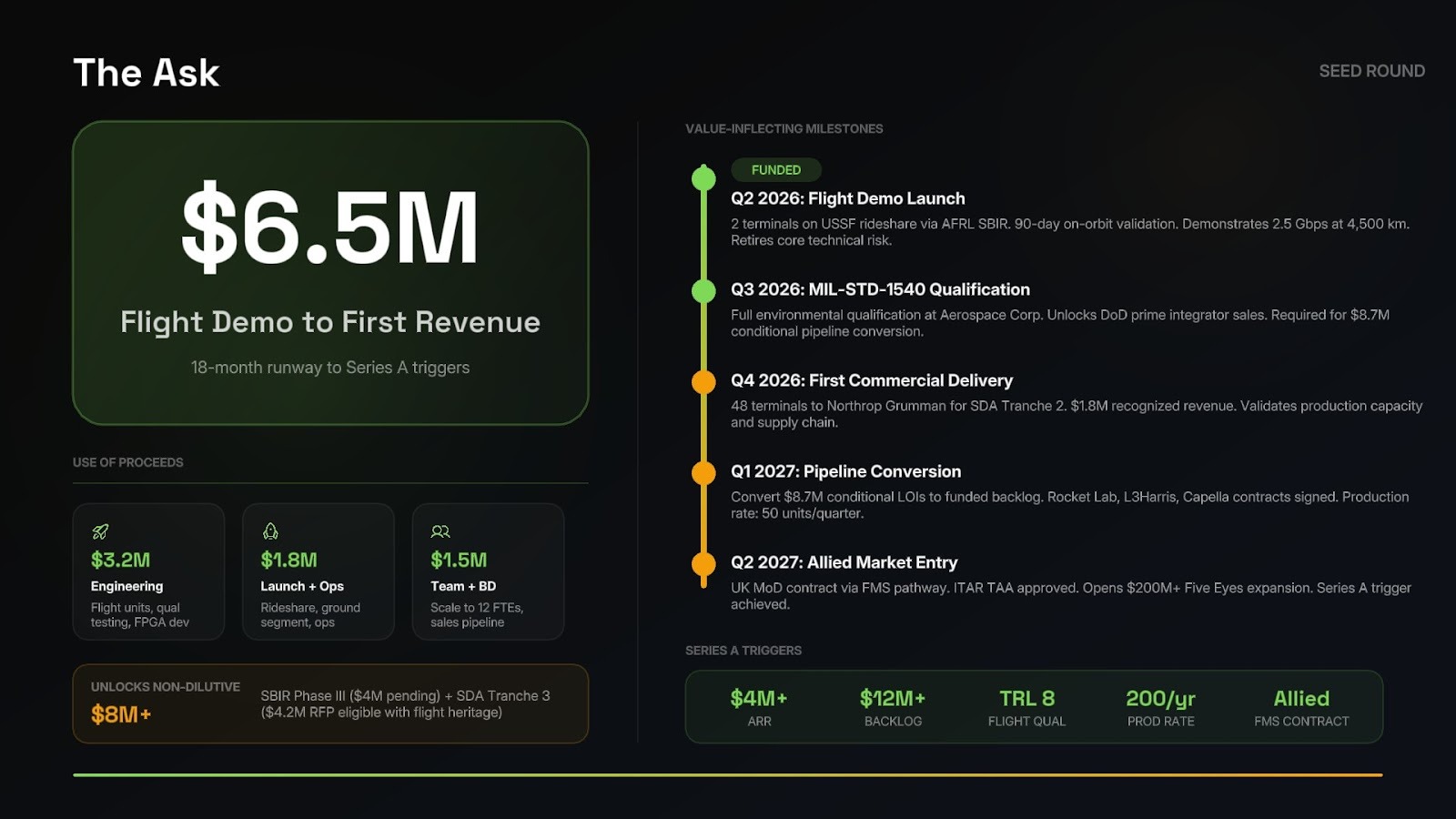
The Ask: Use of proceeds and round size
The ask shows how much you are raising and what you plan to accomplish with it. We wrote about choosing how much to raise here.
Defense fundraising has a distinct structure: the government is often both your development partner and your end customer, and the capital stack typically includes SBIR/STTR grants, OTA contracts, and program-of-record pursuit alongside private equity. Your fundraising needs should show that you understand this structure and have a strategy that doesn't make you purely dependent on VC capital to reach revenue.
How to frame it:
Be explicit about the role of non-dilutive government capital in your plan. "This $4M raise is designed to bridge our Phase II SBIR to an OTA contract, fund a small commercial team to pursue allied government customers, and reach first revenue before our Series A." Show that you're using VC capital to accelerate, not to substitute for government funding.
What gets VCs excited
- Clear non-dilutive funding strategy: SBIR Phases I/II/III, OTA contracts, CDAO or service branch program funding
- Milestone tied to a government contract or program-of-record entry point, not just a technical deliverable
- Dual-use commercial pathway that allows private sector revenue to reduce government dependency
- Understanding of ITAR, export control, and facility clearance requirements and their cost and timeline implications
- Raise sized to reach a proof point that unlocks either a follow-on government contract or a strategic investor
Red flags
- Raise entirely dependent on continued SBIR funding without a path to OTA or program revenue
- No ITAR or clearance strategy—these requirements add real cost and time and must be budgeted
- Assuming government program timelines will hold—they almost never do
- No commercial or allied partner pathway to diversify revenue beyond a single U.S. program
- Raise sized on contract value that hasn't been awarded yet
Pitching
Do's and don'ts of pitching your defense startup to VCs
The best defense pitches are conversational. Answers should be succinct yet demonstrate operational and procurement depth.
Great founders in defense can explain exactly how their solution will get on contract: not just technically, but through specific contract vehicles, program office relationships, and acquisition timelines. They understand the path to scale and can map how the business will evolve at each procurement gate.
Do
- Be honest about program risk—not just technical risk: Investors appreciate 'we're at TRL 5, the next gate is an operational demonstration, and the program office has committed to a test event in Q3' far more than false confidence. Defense programs slip. Acknowledge the schedule risk and show you have a plan.
- Know your acquisition strategy cold: Be able to walk through your path to revenue: SBIR Phase I → Phase II → OTA prototype → LRIP → FRP, or an alternative route, with specific vehicles, program offices, and timelines.
- Demonstrate operational intimacy: Drop specific details that show you've spent real time with customers: 'The S6 at Camp Pendleton told us their biggest pain is EW deconfliction during combined arms training' is worth more than any market research slide.
- Address the prime integrator question proactively: Don't wait to be asked 'why won't Raytheon build this?' Answer it on your competition slide and be ready to go two levels deeper.
- Lean into your unfair advantages: Existing clearances, government facility access, SBIR awards, program relationships, and classified performance data are genuine differentiators in defense.
Don't
- Don't use military jargon as a substitute for clarity: Acronym soup signals in-group membership but obscures whether you actually understand the business problem. Define your acronyms.
- Don't dismiss the commercial market: Even defense-primary founders should articulate a dual-use angle. VCs worry about regulatory and political risk in defense—a commercial market backstop materially reduces that risk and provides a revenue bridge if defense procurement timelines slip.
- Don't present a research roadmap as a company roadmap: If your milestones are TRL gates with no reference to contracts, customers, or revenue events, you are pitching a lab—not a startup. Every technical milestone should map to a commercial or contract outcome.
- Don't ignore the exit question: Defense tech exits are real—Anduril, Shield AI, Palantir, and Kratos are public benchmarks. Be thoughtful: ITAR constraints, foreign buyer restrictions, and sole-source program relationships create unique M&A dynamics. Show you've thought about it.
We hope this guide was useful to you! If you'd like to get in touch, don't hesitate to reach out to Julian.Capital or Overmatch, and apply in <1 minute to get put in touch with thesis fit investors for free at DeepChecks.VC.