Food & Ag Sector: How to Write Your Pitch Deck















Want to know exactly how VCs evaluate your food & ag startup?
Together with FTW and Ponderosa — some of the leading food & ag VCs— we’ve built this guide to unpack the inside baseball on how VCs evaluate food & ag startups, and in turn how you can raise a successful round.
Informed by the thousands of decks we’ve reviewed, and insights on which startups get the most traction on Deep Checks, this playbook helps put together a teaser deck that gets your first VC pitch scheduled.
We’ll go slide by slide on how investors decide whether or not to move forward with a startup. It’ll cover:
- Problem: Demonstrating you’re solving a burning pain point for your customers
- Solution: Show why you have the best solution to this problem
- Technical risk: How to convince investors to get behind the remaining technical risk that you have
- Why now?: Demonstrating why your startup has just become possible to build. This is make-or-break for many pitches
- Traction: How to show there’s demand for your product before the market has adopted it
- Business Model: How VCs think about your economics
- Market Size: Why bottom up beats top down
- Go to market: Showing you can become big enough, fast enough
- Competition: As markets become crowded, how to create defensibility
- Team: What makes for a world-class founding team?
- The Ask: Use of proceeds and round size
- Pitching: Do’s and dont’s of pitching your startup to VCs
Problem
Demonstrating you're solving a burning pain point for your customers
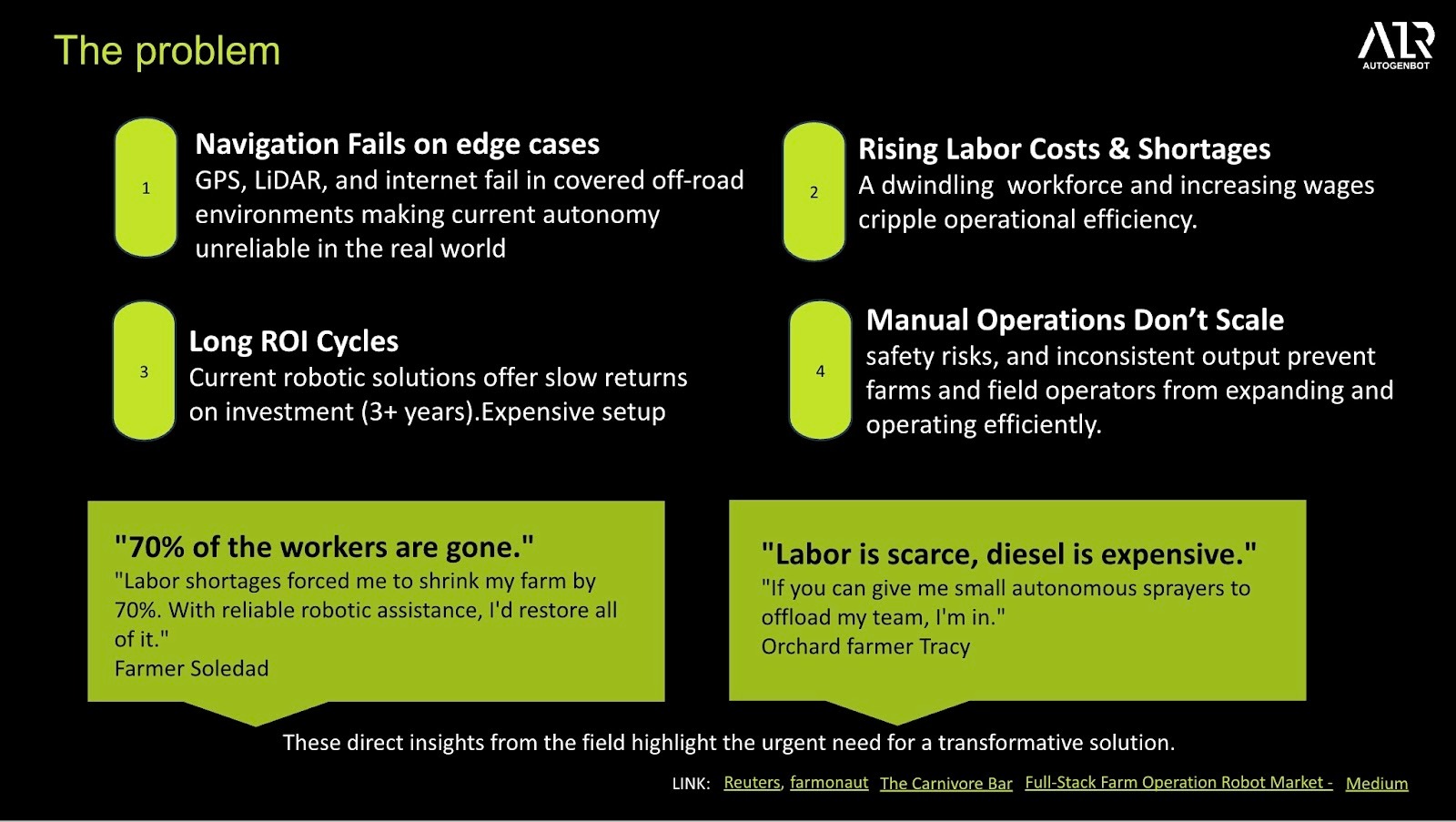
The problem slide exists to convince VCs the pain point you’re solving for your customers is a large, distinct, burning issue that they are willing to endure switching costs to solve, or take the risk against maintaining the status quo.
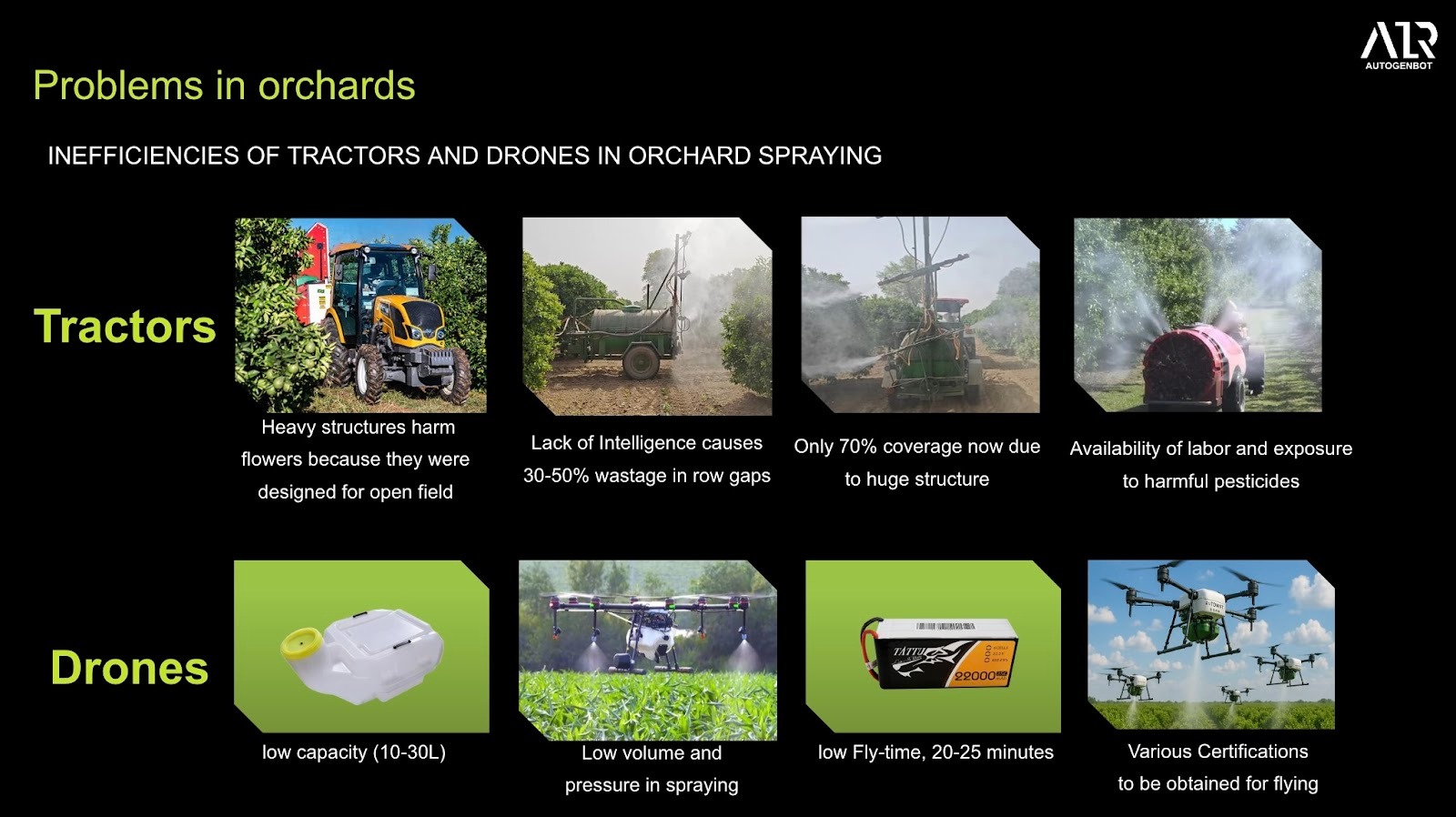
Food and agriculture problems typically fall into one of five categories: labor scarcity/cost, input efficiency/sustainability, yield/quality inconsistency, supply chain waste/spoilage, or changing consumer demands. The most compelling pitches demonstrate the explicit pain point in economic or logistical terms felt by your end customer. For example:
- Labor trends: Decreasing labor availability and high attrition leads to increasing labor costs, lack of available workers, and staffing challenges
- Input efficiency: Fertilizer costs up 200% since 2020, overuse causes 10% loss in COGS per farm.
- Yield variability: Corn yields varying 30-50 bu/acre field-to-field on the same farm costs growers $150-300/acre in lost revenue.
- Supply chain losses: 30-40% of fresh produce spoil between farm and consumer representing $400B annual loss.
- Consumer/regulatory shifts: Health consciousness boosts demand for locally sourced, ethically raised products.
The dirty secret in Ag Tech is that no one wants to try anything that's going to risk the productivity of their current business. Growers only have so many 'seasons' of growing in their lifespan - lets say 45 growing seasons, and you promise an increase in crop productivity with your tech, but they have to pilot it for 3-4 seasons to see impact, that's verging on 10% of their growing 'life'. That's a huge risk if the new solution doesn't work.
With this in mind, the best way to describe the problem your customers face is to start with a slide that outlines the general industry challenge that you are addressing. From here, the next slide should outline the specific problem your end customers face, and the direct business implications of it.
What gets VCs excited
- Problems where the economic pain is 5-10x the cost of the solution (e.g., crop losses of $500/acre vs. solution cost of $50-80/acre)
- Structural problems getting worse over time (labor shortage, water scarcity, climate volatility, input costs, regulatory pressure)
- Evidence that farmers/food companies have tried to solve this and failed (shows urgency and validates that simple solutions don't work)
- Clear willingness to pay demonstrated through current expensive workarounds (premium labor rates, crop insurance)
- Problems affecting a large % of production in major crops/proteins
- Regulatory or buyer mandates creating adoption tailwinds (retailer sustainability requirements, government programs, export certifications, vilification of chemical colorants/additives)
Red flags
- "Nice to have" optimizations that farmers aren't actively trying to solve today
- Problems that only affect premium/niche segments (organic, high-end restaurants) without clear path to mainstream
- Focusing on technology capabilities ("better sensors") rather than economic outcomes ("$200/acre yield increase")
- Problems that require significant farmer behavior change without compelling ROI (<12-24 month payback)
Solution
Show why your solution is the best solution to this problem
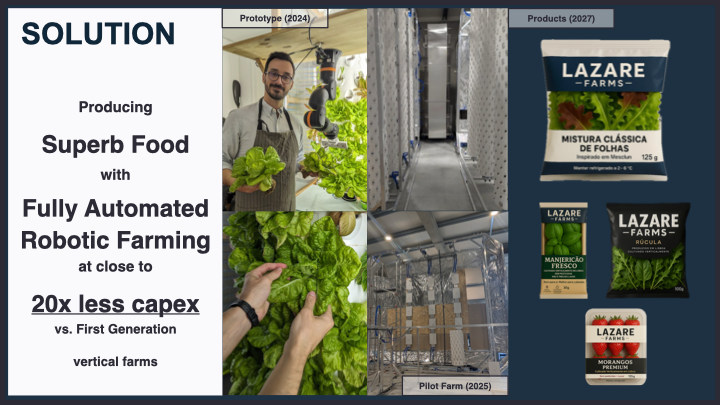
Effective solution slides bridge technology capability to farm-level ROI or food company margin improvement. You should demonstrate what your solution is, framed by the economic and operational impact to your customers:
- Quantified performance in customer terms: "Reduces nitrogen application by 30% while maintaining yield, saving $85/acre in fertilizer costs" not "Optimizes nutrient management". These should be verified by reputable 3rd parties with testing on pilot farms/facilities.
- Direct cost/benefit comparison: "$60/acre annual subscription vs. $200-400/acre in yield improvement = 3-7x ROI in first year" with clear payback timeline
- Operational simplicity: "No infrastructure installation required, works with existing equipment" or "Reduces labor requirement from 4 workers to 1" showing ease of adoption. Farmers are busy, resource constrained, and risk averse. The case for adoption must be made clear and simple.
- Risk reduction/consistency: "Reduces yield variability from ±25% to ±8% enabling better contracting" or "Lowers rejection rate from 18% to 4%"
For ag solutions, you must address why your approach beats: (1) continuing current practices, (2) simple interventions (different timing/rates), (3) existing precision ag tools, and (4) competitive new solutions.
For food tech, you must show: (1) consumer acceptance at target price point and early indications of demand, (2) manufacturability at food-grade scale, (3) regulatory pathway (FDA/USDA), (4) shelf stability and distribution compatibility.
In turn, your solution slide should detail what your product is, and the precise benefits to your customer. Ideally, you are able to convey a distinct insight you have uniquely discovered through sector expertise or customer discovery.
What gets VCs excited
- Clear payback under 2 years for farm-level solutions, under 12 months for food company solutions. Many ag solutions will take 1 year to pilot, 2 to receive results, and 3 to begin to scale.
- Solutions addressing multiple pain points: reduces costs, improves yield, and lowers risk simultaneously
- Evidence from actual farm/production trials across multiple sites, seasons, and conditions (not just controlled environments)
- Solutions compatible with existing equipment/infrastructure/processes
- Platform potential: initial application proven, clear expansion to adjacent crops/species/processes
- For food: clear indications of consumer demand through pre-orders, comparable companies, purchase trends, etc.
Red flags
- Long payback periods for farm solutions
- Leading with technology specs ("IoT sensors with ML models") before showing grower value
- Comparing only to status quo without addressing why other emerging solutions won’t work
- Food products with taste/texture/appearance that consumers reject in blind tests
- Requiring complete farm system changes (new equipment, infrastructure, practices) for marginal gains
- Solutions that only work in perfect conditions (fail when stressed by weather, pests, equipment failures)
- Ignoring seasonality, weather dependency, or biological variability in claimed results
Technical Risk
How to convince investors to get behind the remaining technical risk that you have
After your solution slide, investors will want to know what your technology is, what your unique insight to be able to build it was, and what its technical readiness level is.
In showing this, keep in mind:
Deeptech venture investors typically accept engineering risk (if your team can credibly tackle it and it's technically feasible) but not scientific risk (where your product might simply not work). Early stage VCs want to know:
- What has been proven
- What needs to be proven (within technical efficacy, system efficiency, technoeconomics, or scale-up)
- Why you're confident you'll achieve this (known engineering problems are far more credible than "it works in the lab but has never scaled to the field")
Food and ag technologies face unique technical risks: biological variability, environmental dependencies, food safety requirements, and regulatory hurdles. Be ready to talk through what your pathway to efficacy across representative conditions will be and potential failure modes. For food tech, the focus is on food-grade production.
For ag-tech, these area areas that help get investors over the hurdle to a meeting:
- Field validation: Demonstrated across multiple farms, geographies, weather conditions, soil types for at least one full growing season.
- Scalability proven: For hardware - a path to efficacy at scale and within the performance metrics you predict. For biologicals - a path to demonstration across potential farm conditions.
- Integration with farm operations: Works with farmers' existing equipment, practices, and workflows. Tolerates real-world conditions (dust, temperature extremes, rough handling).
For food tech:
- Pilot-scale production: Feasibility of production at pilot scale is outlined, a path to commercial scale is identified.
- Formulation stability: Shelf life, temperature tolerance, packaging compatibility.
- Taste validation: Consumer taste tests showing acceptance at target price
- Manufacturing pathway: Identified co-packers or contract manufacturers with relevant capabilities
- Note: Sensor driven businesses have their own set of metrics tied to operational improvements.
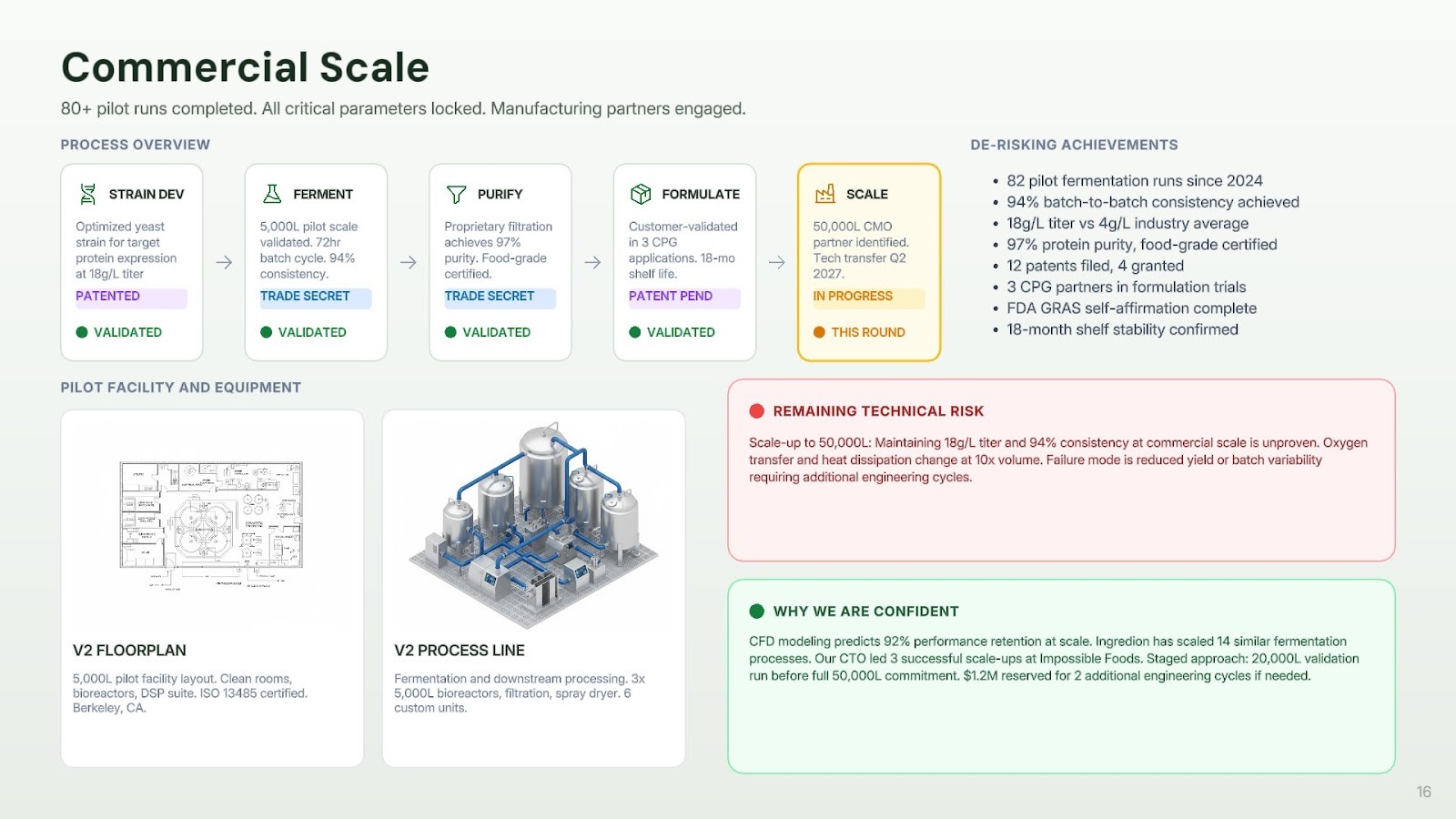
Your technical risk slide should show how far across these areas you’ve been able to de-risk. It might include technical diagrams, TRL, and demonstrated performance specs.
What gets VCs excited
- A path to field data showing consistent results across variable conditions
- Farmers/food companies currently using your solution in commercial operations (even small scale). The best result is customers giving strong usage data, and indicating that their ability to operate without your technology is low. Meaning after they adopt, they have immense enthusiasm to sign contracts and expand usage.
- Clear understanding of failure modes and mitigation strategies
- Regulatory pathway de-risked through expert consultants, pre-submission meetings, or similar products approved
- Strong IP protecting core innovation: genetics, formulations, algorithms, or hardware design
- Path to continuous improvement: data accumulation, genetic advancement, or formulation optimization creating a moat
Red flags
- Still at greenhouse/lab scale at seed stage without clear path to field validation
- Single-season, single-location data claimed as proof of commercial viability
- Food products with no consumer testing or only tested on friends/family
- No understanding of regulatory requirements or claiming "not regulated" incorrectly
- Technology requiring perfect conditions (fails if too hot, too cold, too wet, too dry)
Why Now
Demonstrating why your startup has just become possible to build
Agriculture has resisted technology adoption for decades due to thin margins, risk aversion, and failed promises from ag-tech companies. What's different now is the convergence of crisis-level challenges (labor, water, climate, input costs) meeting mature enabling technologies (AI, gene editing, precision fermentation) and policy/market tailwinds (sustainability mandates, climate funding). The best "why now" narratives show farmers/food companies are desperate for solutions, and that the technology is finally ready.
There should be a narrative around how there will be adequate customer spend beyond initial trials, in a manner that fits within customer budget cycles - it should be a top 3 problem that demands attention and spend.
Inflection points across technology, policy, consumer behavior, or buyer demand create compelling narratives to demonstrate this. Here are examples we're seeing in 2026:
Demand:
- Permanent labor shortage: U.S. ag labor force declining 30% since 2015 with immigration restrictions limiting recovery, forcing mechanization adoption
- Climate adaptation urgency: Increasing frequency of extreme weather (droughts, floods, heat waves) making traditional practices unviable, creating demand for resilience solutions
- Retailer sustainability requirements: Walmart, Target, major CPG brands mandating scope 3 emissions reductions, regenerative practices from suppliers. Keep in mind regional variation: EU is more adept to track climate initiatives, while the US has been slipping. Know the regulatory and corporate policy constraints within each of your target markets.
Technology:
- Computer vision at commodity prices: Edge AI enabling real-time plant/animal monitoring at <$100/unit vs. $1,000+ previously
- Gene editing accessibility: CRISPR enabling precise crop/livestock improvements
- Precision fermentation maturity: Bioreactor costs declining, enabling production of proteins, fats, flavors at food-grade scale economically
- Satellite + drone proliferation: Daily field-level imagery available at <$5/acre vs. $20+ previously, enabling in-season management
Policy:
- IRA climate incentives unlocking credits for climate-smart agriculture, making sustainable practices economically attractive
- Farm Bill 2024: Expanded crop insurance for sustainable practices, specialty crop support, research funding for ag innovation
- Water regulations tightening: SGMA in California, other states implementing groundwater limits, forcing irrigation efficiency
Consumer behavior:
- Premium for transparency: Consumers willing to pay more for products with verified sustainability/animal welfare claims
- Alt-protein normalization: Increasing purchase of plant-based products
- Local/regenerative premiums: Farmers' markets, CSAs, regenerative-branded products achieving mainstream distribution
Supply chain:
- Input cost volatility: Fertilizer price swings driving demand for efficiency and alternatives
- Pandemic disruptions: Exposed fragility of centralized processing, creating demand for distributed/local solutions
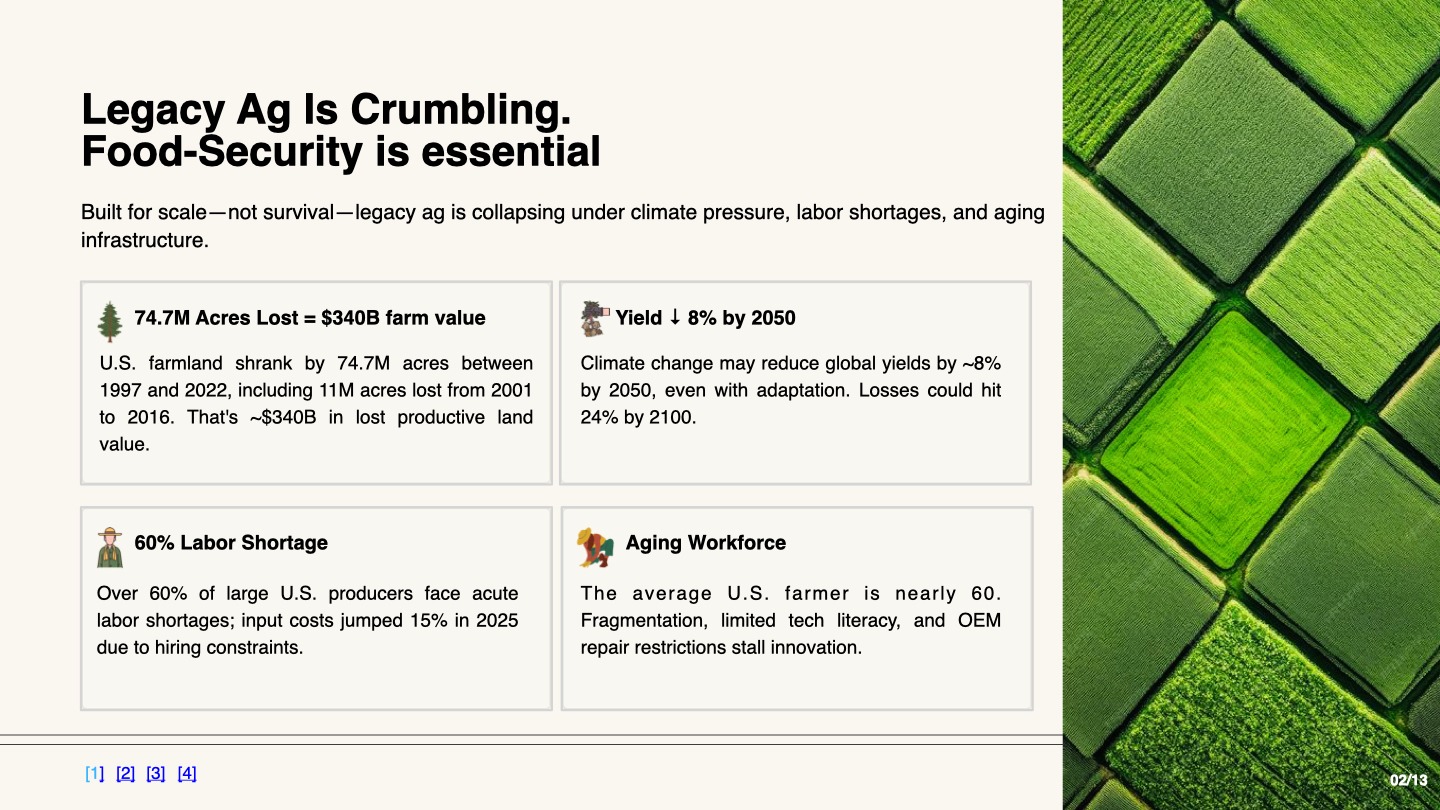
Your “Why Now” slide should demonstrate the particular changes that make your business uniquely possible today.
What gets VCs excited
- Multiple trends making adoption inevitable (labor crisis + climate stress + regulatory pressure)
- Economic inflection points: Input costs, labor rates, or crop prices crossing the threshold that changes the ROI calculation
- Technology maturity: Key enabling technology (sensors, genomics, fermentation) becoming affordable/accessible
- Regulatory tailwinds with funding attached (IRA, Farm Bill programs providing subsidy/cost-share for adoption)
- Durable & growing spend for the problem you’re solving
Red flags
- Generic claims about "sustainability trends" without specific buyer requirements or regulations
- "Why now" based entirely on your technology existing, not market readiness to adopt
- Ignoring history of failed ag-tech companies promising the same benefits in past decades
- Overindexing on technology hype cycles: "Drones will revolutionize agriculture" (2015), "blockchain for food" (2018), etc. - what's different now?
- Connecting “why now” to cyclical conditions vs a durable structural shift. Short-term volatility can drive near-term customer demand, but only structural advantages persist
Traction
How to show there's demand for your product before the market has adopted it
Food and ag traction can be challenging because farmers buy conservatively (1-2 year evaluation cycles) and food companies have rigorous validation requirements (12-24 months for ingredient qualifications).
In light of this, there are three ways you can demonstrate your traction to VCs. From least to most convincing:
Deep problem understanding: Show you grasp your customer's specific challenges by answering: How many customers have you spoken to, and how much time have you spent with growers/operators? Do you understand their purchase economics? Are you solving concrete problems like grid congestion or supply chain gaps? What makes this urgent now versus a future hypothetical? Will customers cite your challenges as key to their own growth, absent your pitch to them? Are they willing to be references, and see you as a credible thought leader in this problem space?
Working demos: Pilot-scale demonstrations that de-risk your technology and economics. Draw clear lines between your demo and what customers need to see for adoption—ideally captured through paid pilots.
Written commitments: Paid demonstrations or commercial agreements. Next best: LOIs specifying purchase conditions and pricing. Customers being willing to serve as reference checks is a strong green flag (and potentially yellow flag if they are not willing to).
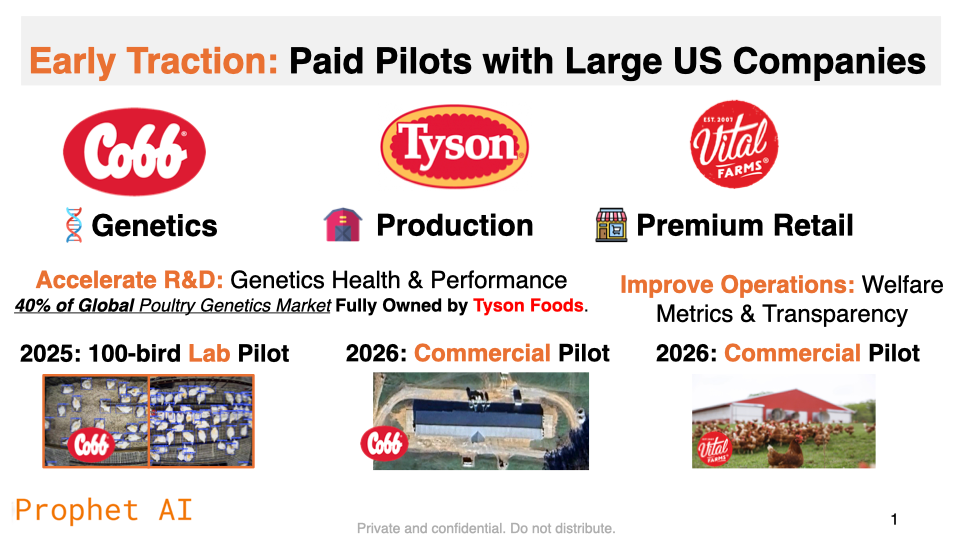
Your traction slide should demonstrate your sales funnel and commercial progress by means of LOIs, pilots, field trials (ideally with a path to multiple locations, across multiple seasons, and with multiple strips of acreage), contracts, etc.
What gets VCs excited
- Paying customers: Any revenue demonstrates you've crossed the credibility threshold with conservative farmers/food companies
- Retention and expansion: Customers coming back for year 2, expanding acres/volume
- Diverse geographies and crops: Traction across regions, crops, farm sizes
- Grower advocates: Farmers willing to host demos, provide testimonials, refer neighbors
- Channel partner interest: Ag dealers, coops, or distributors wanting to carry your product
- Unsolicited inbound: Farmers/companies reaching out after hearing about you
- Competition to get product: Waitlists, pre-orders, or customers willing to pay deposits for future delivery
Red flags
- Only tested in controlled environments (greenhouse, research station) not commercial farms
- LOIs without specific terms: acres, price, conditions, timeline
- Only traction from government grants or pilot programs without commercial pull
- Single customer or geography: Introduces risk of not working across different farm conditions
- For food tech: No consumer testing or only tested on employees/friends
Business Model
How VCs think about your economics
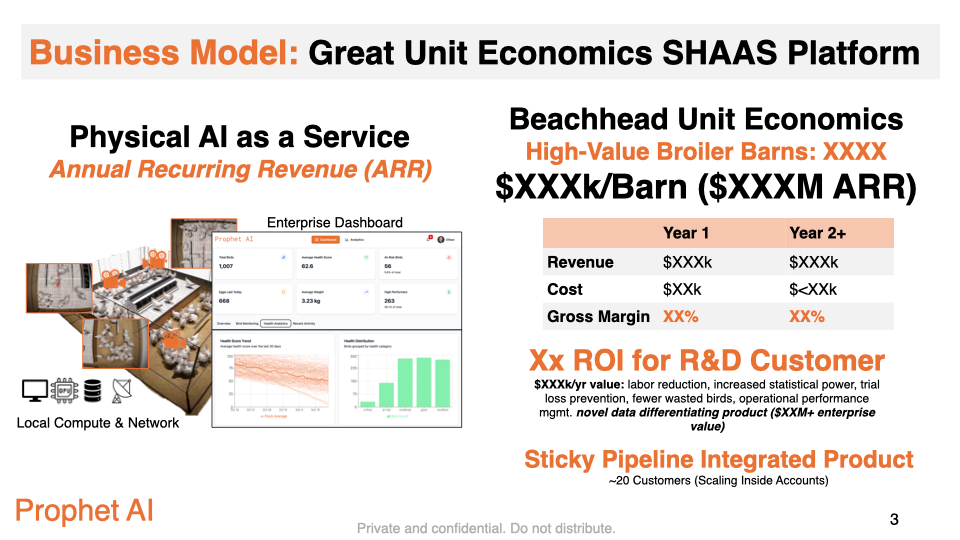
You need to show how you can make venture-scale returns despite operating in a traditionally low-margin industry. The key is demonstrating sustainable gross margins at scale with a clear path from current economics to your target. VCs will want to understand the customer ROI and payback period, as well as your own unit economics and margins.
Some ag-specific economic considerations include:
- Seasonality: Most ag purchases concentrated in spring planting or fall harvest. Plan for working capital needs and seasonal sales spikes.
- Payment terms: Farmers often pay after harvest (6-9 month terms). Food companies 30-90 day terms. Factor into cash flow.
- Channel markups: Ag dealers and food distributors will eat into your margin. If these are part of your distribution, factor this into your financial model assumptions.
As such, your business model slide should include the basics of how you make money, the high level economics of price point to end customers, and margin you are able to achieve yourself.
What gets VCs excited
- Clear path to strong gross margins at scale.
- Recurring revenue models creating predictable, growing cash flow
- Unit economics improving with scale
- Multiple revenue streams: product + service + data creating resilience
Red flags
- Long time frames to contract, or positive economics
- Business model requires tens of thousands of customers to reach profitability
- Economics entirely dependent on government subsidies or carbon credits
- Pricing that doesn't work with channel markups - many businesses don’t get enough revenue/acre to justify sales.
- Food products priced 2x+ above comparable items without clear differentiation
- No clear understanding of cost structure or path to target margins
- Ignoring working capital requirements (ag seasonality can require 6-12 months operating capital)
Market Size
Why bottom up beats top down
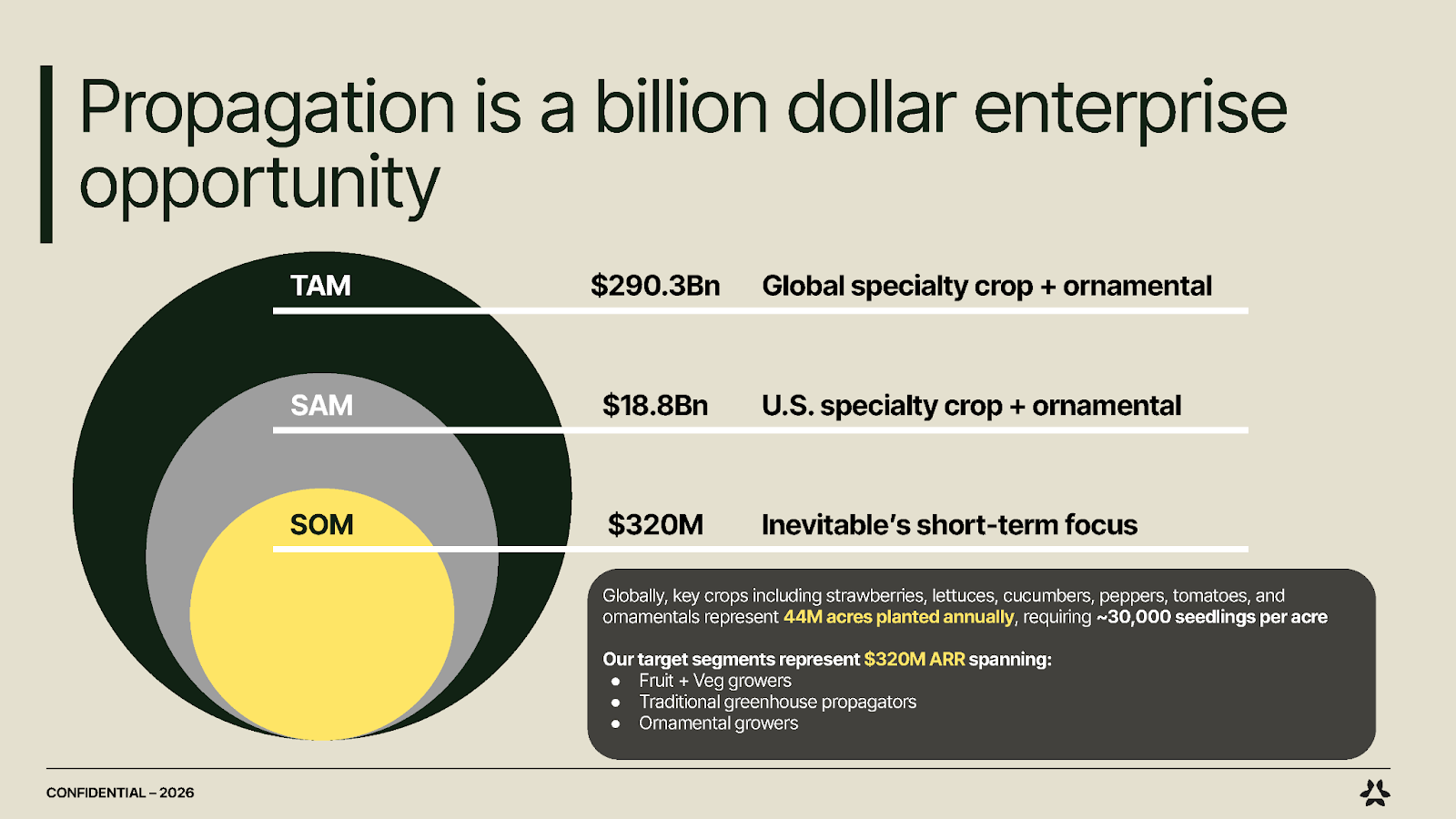
Your market sizing slide should be broken down into your:
Total Addressable Market (TAM) The total revenue opportunity if you achieved 100% market share across all potential customers globally. Total potential customers × Annual revenue per customer
Serviceable Addressable Market (SAM) The portion of TAM you can realistically reach given your business model, geographic focus, and current capabilities. Customers matching your target profile and location × Annual revenue per customer
Serviceable Obtainable Market (SOM) The market share you can realistically capture in the next 1-3 years, accounting for competition and resources. SAM × Realistic market share % that you could target over the next few years
This method of calculating these numbers is much preferred to “top down” market sizing, where you infer total demand based on high level industry numbers. This is because VCs want to understand how large your business can get - the TAM might be $5B, but if you price 1/10th of comparable products, the amount of market you can capture might be $500M.
Though it is acceptable (not desirable) to lean towards top down if bottom up is hard to quantify, and it is ok to use projections for market size so long as it’s clear how you’re arriving at your conclusions (ie TAM is based on 2030 estimates).
A bottom-up market sizing from specific crops, geographies, and farm types (or users relevant to food offtake or purchase) lends to the greatest degree of credibility.
What gets VCs excited
- Large markets with validated demand: customers already spending money trying to solve the problem
- Bottom-up math validated by farmer conversations
- Geographic expansion potential
Red flags
- Top-down from massive ag economy ("$1 trillion ag industry, we'll get 0.1%")
- Market size entirely dependent on winning single major customer or crop
- No segmentation by geography, farm size, or crop type - treating all opportunities as equal
- Total addressable market under $5B
Go to Market
Showing you can become big enough, fast enough
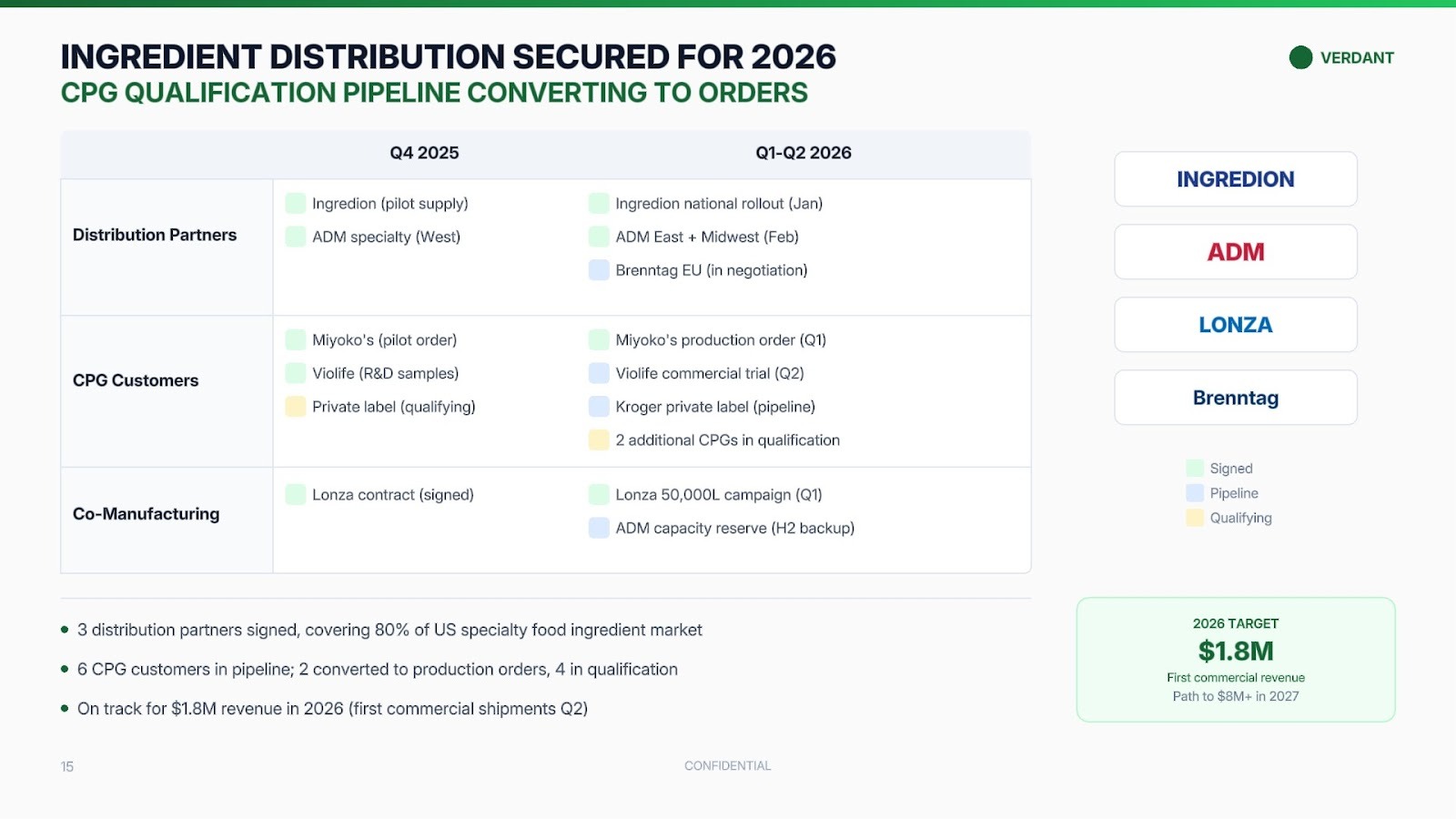
This slide should outline who your customers will be, how you reach them, and how you will stage your rollout as your footprint grows. VCs use this to determine if you can support venture-scale revenue (usually $100M+) within the decade timeframe of a fund.
For agriculture companies, GTM requires understanding farmer buying behavior (conservative, relationship-driven, seasonal), dealer/distributor dynamics (margin requirements, territory exclusivity), and the importance of word-of-mouth in ag communities. The challenge is ag sales are often seasonal, geographically concentrated, and require extensive hand-holding early on. Your GTM must show path from founder-led sales to scalable channel distribution.
It also necessitates a clear understanding of the regulatory approval timeline unique to your market, and how this affects your speed to revenue.
For food companies, you must be able to demonstrate a path to manufacturing or co-production, and how you work towards distributor partnerships from direct initial sales.
As such, this slide should outline how you reach your customers, and how you will stage your GTM if your customer type changes with scale. Within the pitch, the most important question to answer is how your GTM motion can support a venture scale amount of revenue (usually $100M+) within the decade timeframe of a venture fund. VCs will generally use this slide to get to understand your depth of knowledge on the sales cycle as well.
What gets VCs excited
- Named target customers with a specific engagement strategy
- Channel partnerships already established or in discussion (LOIs with coops, distributors expressing interest)
- Geographic clustering strategy: Dominate specific regions before expanding, or have a multi-region strategy to take advantage of extended growing periods.
Red flags
- Vague GTM ("We'll sell to farmers") without specific crop, region, or farm size targets
- Dealer strategy without understanding their margin requirements
- Ignoring seasonality: farmers buy in spring, food companies budget annually (need to align with cycles)
Competition
As markets become crowded, how to create defensibility
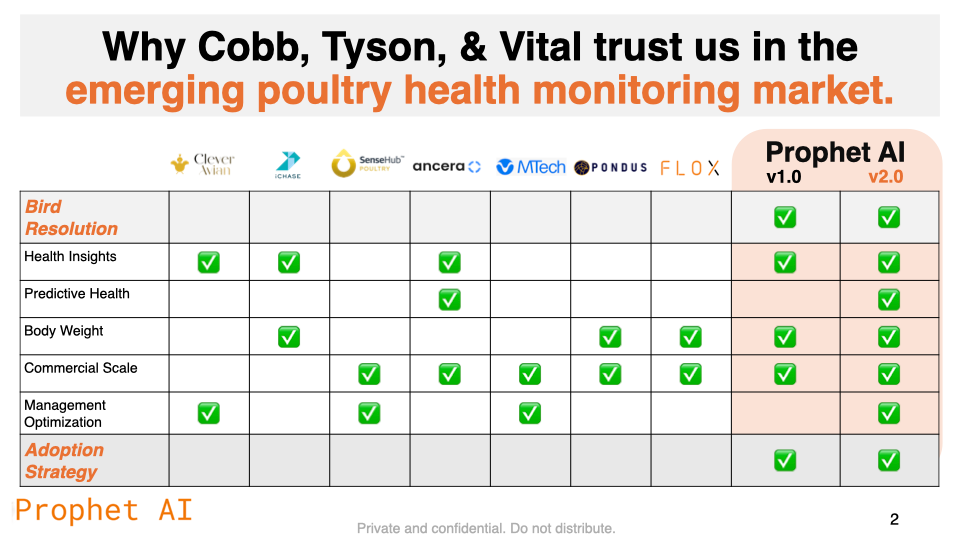
The strongest defensibility arguments show your solution is directionally impossible or highly unlikely for top incumbents to build themselves. It should be technically novel, challenging to replicate without your team's specific expertise, and protected by IP. Over time, becoming a trusted industry leader and achieving economies of scale creates durable advantages over future competitors.
Agriculture defensibility commonly begins with biological and technical IP—proprietary genetics, novel formulations, sensor-driven data algorithms, and patented hardware—reinforced by costly regulatory barriers like EPA/USDA registrations and organic certifications. Over time, defensibility becomes more entrenched with data moats from growing farm networks, trusted grower and dealer relationships, and operational advantages in supply chain and manufacturing scale that new entrants struggle to replicate.
Defensibility for food startups commonly begins with taste and formulation IP that's difficult to reverse-engineer, along with proprietary manufacturing processes like precision fermentation and bioreactor optimization. Over time, defensibility becomes more entrenched with consumer brand loyalty and hard-won retail relationships, since shelf space is limited and distribution partnerships take years to build.
Note that things like speed to market, degree of demand, and your own ability to adapt are likely to be more relevant to success initially than competitive positioning. Keep the former in mind, while crafting a narrative around the latter.
Your competitive slide should demonstrate why your solution is superior to your competitors and incumbents.
What gets VCs excited
- Multiple overlapping defensibility mechanisms (IP + regulatory + network effects + brand)
- Speed of sales/revenue - if you can get to market faster than competition, you can gain a ton of ground before your technical moat kicks in.
- Strong patent portfolio
- Proprietary data: Unique datasets from thousands of farms/fields that improve product performance
- Grower lock-in: Multi-year contracts, genetic dependencies (next season requires your seed), or equipment integration
Red flags
- Claiming no competition when John Deere, Bayer, or major food companies could enter
- Solutions that aren’t significantly more effective than competition. Customers will stick to less effective solutions to mitigate risk, but will switch for order of magnitude improvements.
- Underestimating industry dynamics - such as an inferior product winning for structural reasons such as entrenchment, familiarity, safety.
- Defensibility based solely on being first without structural barriers to fast followers
- Underestimating how quickly large ag/food companies can copy if market proves attractive
- For food: Taste/formulation not truly differentiated
Team
What makes for a world-class founding team?
At Julian Capital, we’ve written about what makes a great founding team here. We're excited by founding teams who are:
- Commercially minded with technical depth
- Building their life's work—the culmination of their career or their final pursuit
- Relentlessly resourceful with high agency
- Persuasive and authentic storytellers
- Comprehensive in thinking through all business avenues (GTM, competitive landscape, bottom-up TAM, etc)
Food and ag ventures require technical depth (agronomy, food science, biology), farming/food industry credibility, commercial capability. The strongest founding teams combine:
- Deep technical expertise: Relevant technical expertise to be uniquely capable to build and hire to scale your product.
- Farming/food industry experience: Someone who has actually farmed, worked in food manufacturing, or spent years in the ag industry. Understands real-world constraints: weather, pests, equipment failures, seasonality, food safety. Knows what farmers actually care about vs. academic theories.
- Commercial/GTM capability: Someone who can sell to conservative farmers or navigate food company procurement. Understands dealer economics, co-op dynamics, or food company buying processes.
Key background signals VCs look for:
- Academic pedigree: PhD from top ag/food programs (UC Davis, Cornell, Wageningen, Iowa State, Purdue). Research experience at land grant universities or USDA.
- Industry experience: Worked at major ag companies (Bayer, Corteva, Syngenta, John Deere), food companies (Cargill, ADM, Nestle, Danone), or successful ag-tech startups (Climate Corp, Farmers Business Network, Indigo).
- Farming background: Grew up on a farm, operated a farm, or worked for farms. Credibility with grower customers and real understanding of operational challenges.
- Strong networks: Relationships with growers, dealers, agronomists, or food company buyers enabling customer access.
- Complementary skills: Team covers agronomy/biology, engineering/technology, business/sales.
You certainly don’t need to have all these qualities in your founding team. But your team slide should demonstrate the backgrounds of your cofounders in a way that highlights qualities representative of this list.
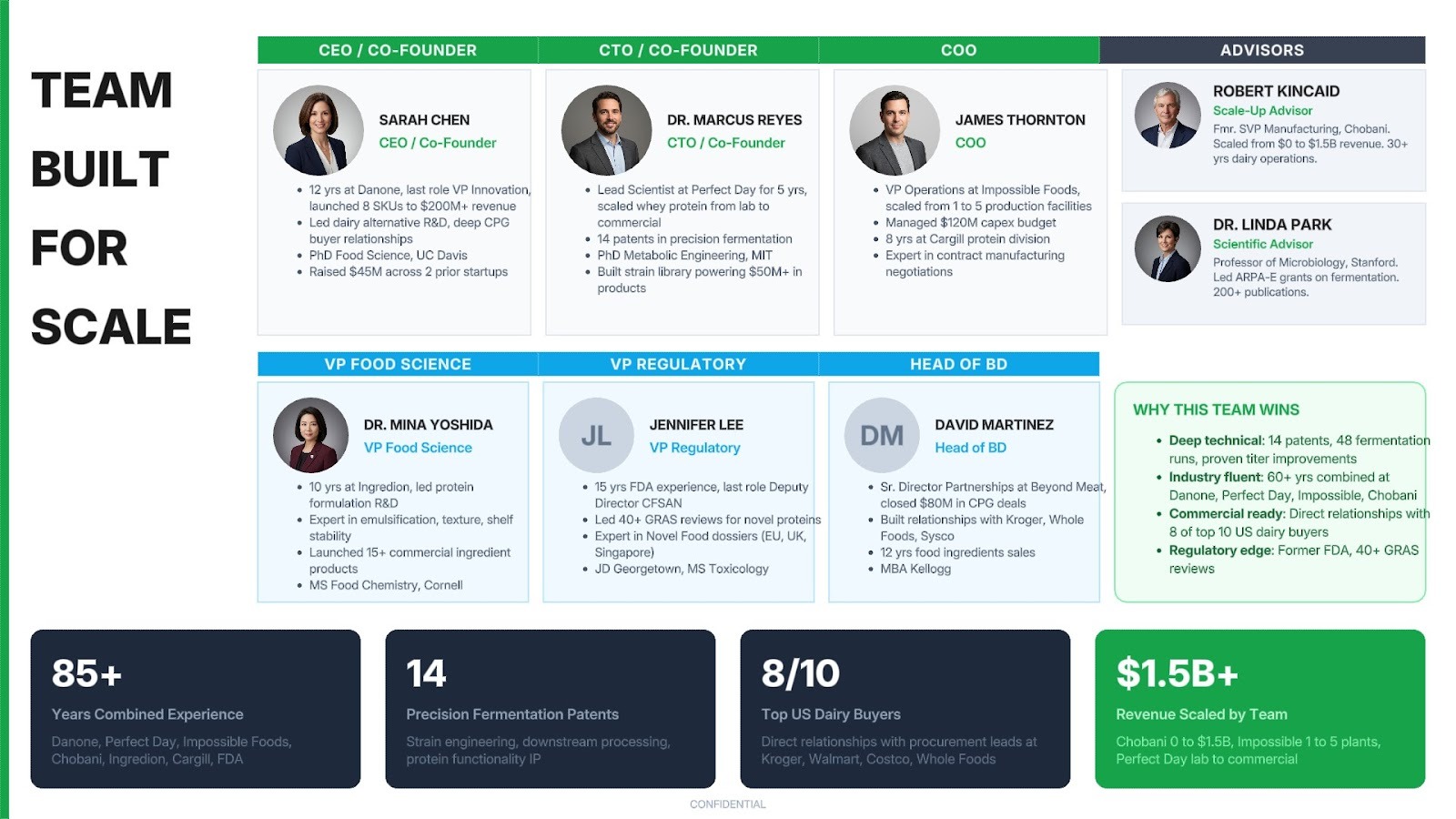
What gets VCs excited
- Teams combining deep technical expertise, farming/food industry credibility, and commercial orientation
- Founders who have farmed or worked in ag/food industry
- Strong industry relationships providing immediate customer access
- Track record of getting products to market through development, registration, and commercialization
- Ability to recruit top talent: Quality of first 5-10 hires (agronomists, engineers, sales) signals team's appeal
- Mission-driven founders committed long-term
Red flags
- Teams without technical depth (trying to build on licensed technology or outsourced R&D)
- Founders who can't talk to farmers in their language (too technical or theoretical)
- Founders that assume conditions in the supply or distribution chain, that have not been validated by personal experience or customer discovery
The Ask
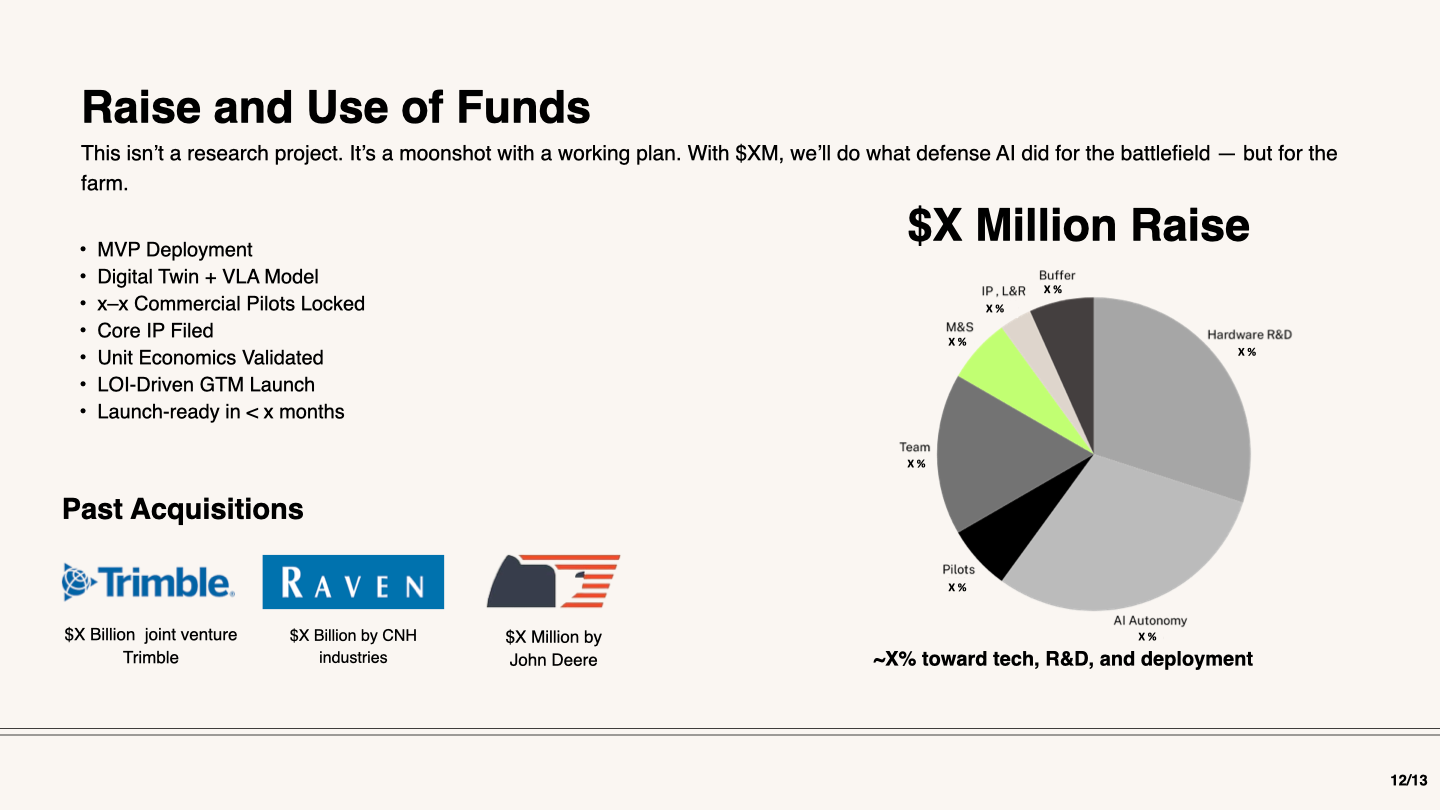
The ask shows how much you are raising and what you plan to accomplish with it. We wrote about choosing how much to raise here.
Food and agriculture startups often underestimate the time and cost of field validation, regulatory approvals, and the slow purchasing cycles of agricultural customers. Your ask should be sized to generate the kind of replicated, statistically valid performance data that ag buyers and food companies require before committing.
Frame your raise around the evidence required to unlock your next commercial, technical, and supply chain milestones: "This $3.5M round funds two full growing seasons of field trials across three geographies, an EPA or FDA submission, and our first commercial supply agreement." Be specific about regulatory requirements and what they cost.
What gets VCs excited
- Raise sized to generate statistically meaningful field or production data across multiple seasons, geographies, or crop types
- Clarity on regulatory pathway (EPA, FDA, USDA) with realistic timeline and budget
- Pilot agreements with ag distributors, food companies, or growers that will fund or co-fund validation work
- Non-dilutive funding strategy—USDA SBIR, NIFA, ARPA-E OPEN—to extend runway
- Milestone clarity: what yield improvement, cost reduction, or shelf-life extension defines success for this round
Red flags
- Raising for a single growing season of data—insufficient for most commercial buyers
- No regulatory budget or timeline—submissions take longer and cost more than founders expect
- Assuming distribution partnerships before product validation is complete
- Round sized on projected revenue from a single customer without pipeline depth
- Underestimating the working capital needs of a business tied to seasonal production cycles
Pitching: Do's & Dont's
Here's how (and how not) to pitch:
The best pitches are conversational. Answers should be succinct yet demonstrate depth of thought.
Great founders bridge vision with detail. They intimately understand their problem space and can explain it clearly—both the problem and the system around it. They understand the path to scale and can map how the business will evolve getting there.
Common traps food & ag founders fall into:
- Technology-first framing: Leading with "machine learning for crop prediction" instead of "$200/acre yield improvement for corn growers."
- Underestimating farmer conservatism
- Ignoring the impact of seasonality
- Overestimating distribution ease: "We'll just sell through co-ops" without understanding co-ops need 30% margin, exclusivity, marketing support, and farmer pull.
- For food tech: Claiming taste parity without blind consumer testing
- Not knowing the competitive landscape
We hope this guide was useful to you! If you'd like to get in touch, don't hesitate to reach out to Julian.Capital, FTW Ventures, and Ponderosa, and apply in <1 minute to get put in touch with thesis fit investors for free at DeepChecks.VC.