

Cofounders & equity
Do you need a cofounder?
You can't build a deeptech company without a world-class team. Cofounders are usually the people who stay to see the business through, so a solo founder has to make up for that by being exceptional at convincing great people to leave good jobs and join the mission.
We do back solo founders, as long as the founder has the core skill the business depends on and has already hired extremely well for everything else that matters. We want to see a world-class founding engineer or early hire who chose you. Recruiting is one of the hardest and most important jobs a founder has, and in our experience, someone who does it at an A+ level does the rest of the job to the same standard.
Strong teams are spiky
The founding teams we get excited about are spiky. Each founder has a world-class skill or an outlier ability in one of the few areas that decide whether this particular business works, and we care much less about how well-rounded they are.
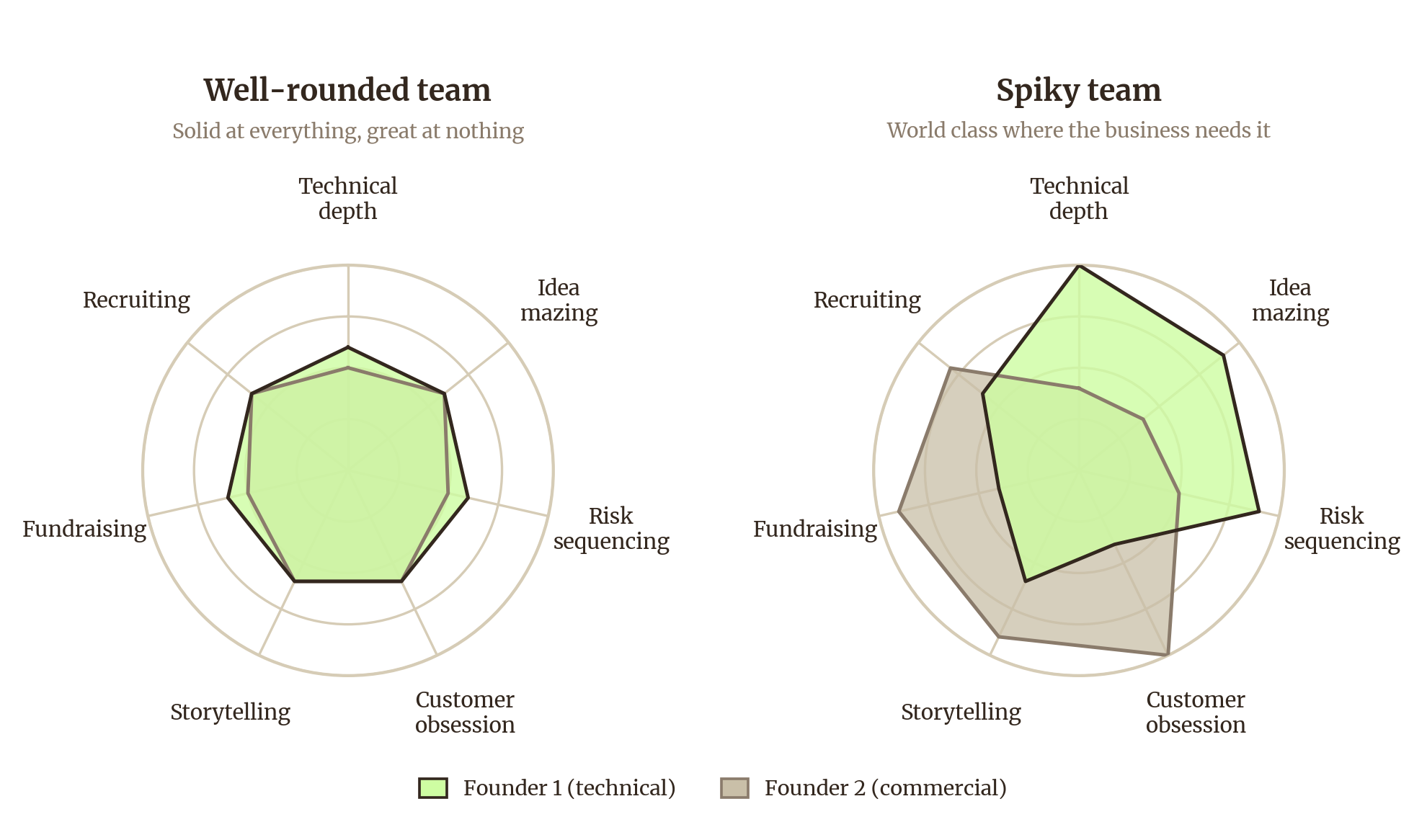
Which spikes matter depends on the company. Our robotics deck guide, for example, describes the strongest teams as combining deep robotics expertise, experience shipping physical products, and real knowledge of the customer's industry.
Search the whole field for a cofounder
If you're in one of the few labs in the world working on your science, your labmate may be the best cofounder you could find. Most of the time, though, investors see hiring within arm's reach as the lazy option. In optimization terms, the nearest good person is a local maximum. It's sometimes also the global maximum, but usually it isn't. So search the field for people who have worked in this space, published the key research, or built a company in it before, and go after the best one. The hiring lesson covers how to recruit people who aren't looking.
Test before you commit
Before you commit to a cofounder, build something together, ship it, and spend a lot of time together. Treat it like dating before marriage.
Put everyone on a vesting schedule
Every founder's shares, including yours, should vest over time with a cliff. The market standard is four years with a one-year cliff: a founder who leaves in the first year walks away with none of their shares, 25% vests at the one-year mark, and the rest vests monthly after that. We believe deeptech founders should go longer, six to eight years. That's the minimum it takes to build one of these companies, so we don't see a reason for vesting to be shorter, though most investors will expect at least four.
What happens without it
Snapchat is the best-known example. Reggie Brown worked on the first version with Evan Spiegel and Bobby Murphy and left the company early. In 2013 he sued, claiming he'd come up with the core idea and was owed a third of the company. Snap settled the following year and, according to its IPO filing, paid him $157.5M. Putting ownership and vesting in writing from day one makes disputes like this much less likely.
Key takeaways
- Solo founders need the core skill plus proof that they can recruit world-class people.
- Strong teams are spiky, with world-class ability in the few areas the business depends on.
- Search the whole field for a cofounder, and hire a labmate only if they're the best person for it.
- Build and ship something together before you commit.
- Put every founder on vesting with a cliff. We like six to eight years for deeptech.
List the four to six abilities your company can't succeed without, and score yourself and any cofounder candidates out of 10 on each.
Any area where nobody on your team scores a 9 or 10 is the gap to recruit for. Next to it, write down who in the world is best at it.